Disease Modification of Pustular Psoriasis by Secukinumab: A 20‐Year Follow‐Up of Von Zumbusch‐Type Generalized Pustular Psoriasis With Evolution Into Annular Pustular Psoriasis—A Case Report
Yu‐Han Alice Hsu, Cheng‐Che E. Lan, Sheng‐Yiao Lin

Abstract
Genes, proteins, chemicals, diseases, species, mutations and cell lines named across the full text — each resolved to its canonical identifier and authoritative record.
Click any figure to enlarge with its caption.
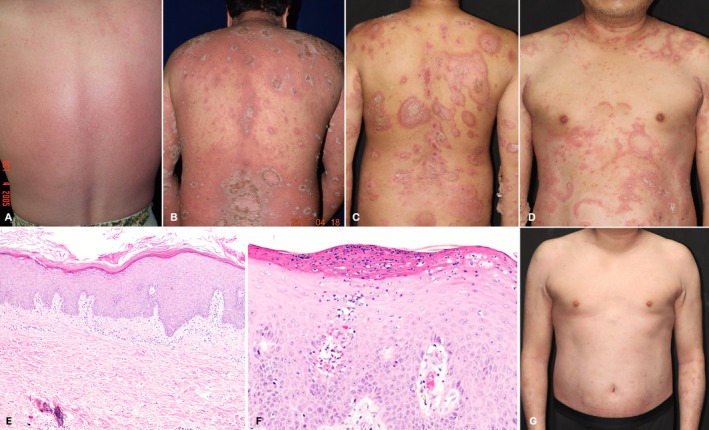 Figure 1
Peer Reviews
No public reviews on file for this paper yet. If you reviewed it on a platform where reviews are public (OpenReview, ICLR, NeurIPS, ICML), you can paste yours below so the community can read it here.
Videos
No videos yet. Explain this paper in a talk, walkthrough, or lecture? Add one.
Taxonomy
TopicsPsoriasis: Treatment and Pathogenesis · Immunodeficiency and Autoimmune Disorders · Autoimmune Bullous Skin Diseases
A 45‐year‐old male with von Zumbusch‐type generalized pustular psoriasis (GPP), diagnosed at age 20, was admitted to our ward with presentation of generalized tiny pustules and erythema with fever and illness during a flare‐up in 2005 (Figure 1A). Despite treatment with cyclosporine, methotrexate, and acitretin, the patient continued to experience recurrent exacerbations. In June 2017, he started treatment with Secukinumab (300 mg at baseline, weeks 1–4, then monthly) and daily acitretin 25 mg, and his skin lesions transitioned from erythema to annular hyperkeratotic plaques with pustules along the edges (Figure 1B). His condition remained stable; however, after discontinuing Secukinumab in July 2023, he experienced a flare‐up in November 2023. Compared to 2017, the pustular plaques were more well‐demarcated with a poly‐annular pattern, characteristic of typical annular pustular psoriasis lesions (Figure 1C,D). There were no symptoms of fever or fatigue. A skin biopsy confirmed pustular psoriasis with psoriasiform acanthosis, subcorneal microabscesses, and proliferated vessels in dermal papillae (Figure 1E,F). Secukinumab was introduced on day 14 of his admission, resulting in significant improvement. The pustules subsided, and skin plaques began desquamating with resolution within a time span of 1 week (Figure 1G). The patient was subsequently discharged with follow‐up at the outpatient department. Afterwards, the patient continued Secukinumab 300 mg monthly, achieving complete clearance for 18 months.
Pustular psoriasis is classified into four types: von Zumbusch‐type GPP, annular pustular psoriasis (APP), exanthematic pustular psoriasis, and localized pustular psoriasis. GPP is characterized by erythematous plaques and pustules, with systemic symptoms like fever, malaise, neutrophilia, elevated C‐reactive protein, hypocalcemia, and abnormal liver function. Life‐threatening complications like sepsis and organ failure can occur [1]. On the other hand, APP is less acute and a more benign variant, characterized by annular or serpiginous lesions with pustules on the edges without systemic involvement [2], with treatment depending on severity. Localized cases use topical therapies like corticosteroids and retinoids, while moderate‐to‐severe cases require systemic treatments such as the application of methotrexate, cyclosporine, acitretin, and biologics. Secukinumab, an IL‐17A monoclonal antibody, effectively reduces inflammation, keratinocyte proliferation, and neutrophil recruitment in GPP.
In this patient with long‐standing Von Zumbusch‐type GPP, Secukinumab modified the disease, transforming it into a less severe form resembling APP, without systemic symptoms. This suggests Secukinumab's potential to reduce severity. Although no reports link Von Zumbusch GPP to APP, Liao et al. noted that severe juvenile‐onset APP unresponsive to treatment can progress to GPP [3]. Secukinumab has successfully treated APP in other cases. Khosravi‐Hafshejani et al. reported sustained clearance in a woman with chronic annular pustular psoriasis [4]. Herrero‐Moyano et al. also documented significant improvement in a woman with severe pustular eruptions after Secukinumab treatment [5].
In conclusion, after a 20‐year follow‐up of a patient with pustular psoriasis, Secukinumab modified the disease course of the severe form of Von Zumbusch‐type GPP to a more benign form of APP. Further studies are needed to investigate the pathogenesis behind the transformation of pustular psoriasis variants and to evaluate the effectiveness of Secukinumab in disease modification of GPP.
Conflicts of Interest
The authors declare no conflicts of interest.
The reference list from the paper itself. Each links out to its DOI / PubMed record.
- 1R. Romiti , A. L. S. Hirayama , M. Arnone , and R. F. Magalhães , “Generalized Pustular Psoriasis (Von Zumbusch),” Anais Brasileiros de Dermatologia 97, no. 1 (2022): 63–74.34838431 10.1016/j.abd.2021.05.011PMC 8799844 · doi ↗ · pubmed ↗
- 2S. E. Choon , A. A. Navarini , and A. Pinter , “Clinical Course and Characteristics of Generalized Pustular Psoriasis,” American Journal of Clinical Dermatology 23, no. Suppl 1 (2022): 21–29.35061227 10.1007/s 40257-021-00654-z PMC 8801409 · doi ↗ · pubmed ↗
- 3P. B. Liao , R. Rubinson , R. Howard , G. Sanchez , and I. J. Frieden , “Annular Pustular Psoriasis—Most Common Form of Pustular Psoriasis in Children: Report of Three Cases and Review of the Literature,” Pediatric Dermatology 19, no. 1 (2002): 19–25.11860564 10.1046/j.1525-1470.2002.00026.x · doi ↗ · pubmed ↗
- 4T. Khosravi‐Hafshejani and J. P. Dutz , “Chronic Annular Pustular Psoriasis Resembling Subcorneal Pustular Dermatosis: A Case Report,” SAGE Open Medical Case Reports 7 (2019): 2050313 X 19857392.10.1177/2050313 X 19857392 PMC 658737931258906 · doi ↗ · pubmed ↗
- 5M. Herrero‐Moyano , T. M. Capusan , C. Martínez‐Mera , M. Llamas‐Velasco , and E. Daudén , “Recalcitrant Annular Pustular Psoriasis Associated With Psoriatic Arthritis Successfully Treated With Secukinumab,” JAAD Case Reports 4, no. 8 (2018): 842–844.30246137 10.1016/j.jdcr.2018.03.016PMC 6146635 · doi ↗ · pubmed ↗