ApoE4 accelerates p‐tau driven tau aggregation and spread in Alzheimer's Disease in a allele‐dose dependent manner
Anna Steward, Anna Dewenter, Sebastian Roemer‐Cassiano, Davina Biel, Zeyu Zhu, Lukas Frontzkowski, Fabian Hirsch, Madleen Klonowksi, Johannes Gnörich, Amir Dehsarvi, Matthias Brendel, Nicolai Franzmeier

TL;DR
This study shows that the ApoE4 gene variant speeds up tau protein spread in Alzheimer's disease, especially in people with two copies of the gene.
Contribution
The study reveals that ApoE4 accelerates tau aggregation and spread in an allele-dose dependent manner, independent of amyloid-beta levels.
Findings
ApoE4 allele dosage significantly influences tau accumulation across connectivity stages, independent of amyloid burden.
Individuals with two ApoE4 alleles show the strongest effect on accelerated tau spreading.
Reducing soluble p-tau in ApoE4 carriers could delay dementia onset.
Abstract
Understanding factors influencing Alzheimer's disease (AD) progression is crucial for optimising treatment timing and targets. A major genetic risk factor, the Apolipoprotein E ε4 allele (ApoE4), is associated with earlier tau pathology accumulation and spread at lower amyloid‐beta (Aβ) levels (Steward, JAMA Neurol, 2023). However, the mechanisms underlying this association remain unclear (Figure 1A). Therefore, we assessed how ApoE4 accelerates Aβ‐related tau aggregation. Specifically, we investigated whether ApoE4 promotes Aβ‐driven secretion of phospho tau (p‐tau) or ptau dependent tau aggregation, and determined whether ApoE4 promotes tau pathology in an allele dose‐dependent manner. We analysed data from APOE‐genotyped AD‐spectrum participants in the ADNI (n = 201) and A4 cohorts (n = 200), integrating cross‐sectional fluid biomarker measures (plasma ptau217, CSF ptau181) and…
Genes, proteins, chemicals, diseases, species, mutations and cell lines named across the full text — each resolved to its canonical identifier and authoritative record.
Click any figure to enlarge with its caption.
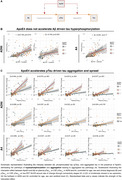 Figure 1
Peer Reviews
No public reviews on file for this paper yet. If you reviewed it on a platform where reviews are public (OpenReview, ICLR, NeurIPS, ICML), you can paste yours below so the community can read it here.
Videos
No videos yet. Explain this paper in a talk, walkthrough, or lecture? Add one.
Taxonomy
TopicsAlzheimer's disease research and treatments · Dementia and Cognitive Impairment Research · Cholinesterase and Neurodegenerative Diseases