Differential Performance of p‐tau217 in Reflecting Amyloid and Tau Stages in Cognitively Unimpaired and Impaired Individuals
Han‐Kyeol Kim, Jae Hoon Lee, Joong‐Hyun Chun, Mina Park, You Jin Kim, Tim West, Kristopher M. Kirmess, Philip B. Verghese, Daniel Connell, Joel B. Braunstein, Young Hoon Ryu, Chul Hyoung Lyoo, Hanna Cho

TL;DR
This study shows that the plasma biomarker p-tau217 performs differently in predicting amyloid and tau stages in people with and without cognitive impairment.
Contribution
The study reveals that p-tau217 reflects amyloid pathology better in cognitively unimpaired individuals and advanced tau pathology in cognitively impaired individuals.
Findings
p-tau217 accurately predicted both early and advanced amyloid stages in cognitively unimpaired individuals with AUCs over 0.9.
In cognitively impaired individuals, p-tau217 showed stronger performance for advanced tau pathology (FTP NEO+) than early tau pathology.
The biomarker's performance for advanced amyloid pathology declined in cognitively impaired individuals compared to unimpaired ones.
Abstract
This study aimed to assess the differential predictive performance of plasma p‐tau217 for early and advanced stages of amyloid and tau pathology in cognitively unimpaired (CU) and cognitively impaired (CI) individuals, evaluating its stage‐specific utility across cognitive states. A total of 237 participants underwent 18F‐florbetaben (FBB) and 18F‐flortaucipir (FTP) PET imaging, as well as plasma biomarker assessments, including p‐tau217, %p‐tau217, and APS2. Participants were categorized as CU or CI based on neuropsychological evaluations. Amyloid pathology stages were defined as FBB G+ (early amyloid pathology) and FBB Str+ (advanced amyloid pathology), while tau pathology stages were classified as FTP MTL+ (early tau pathology) and FTP NEO+ (advanced tau pathology). The predictive performance of p‐tau217 for each stage was assessed using ROC analysis. In the CU group, plasma…
Genes, proteins, chemicals, diseases, species, mutations and cell lines named across the full text — each resolved to its canonical identifier and authoritative record.
Click any figure to enlarge with its caption.
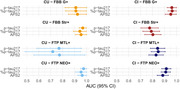 Figure 1
Peer Reviews
No public reviews on file for this paper yet. If you reviewed it on a platform where reviews are public (OpenReview, ICLR, NeurIPS, ICML), you can paste yours below so the community can read it here.
Videos
No videos yet. Explain this paper in a talk, walkthrough, or lecture? Add one.
Taxonomy
TopicsDementia and Cognitive Impairment Research · Alzheimer's disease research and treatments · Functional Brain Connectivity Studies