Choroid Plexus Blood Flow, Not Volume, Drives Cerebrospinal Fluid Turnover in Alzheimer's disease
Liangdong Zhou, Xiuyuan Hugh Wang, Tracy A Butler, Gloria Chiang, Mony J. de Leon, Yi Li

TL;DR
This study finds that blood flow in the choroid plexus, not its size, is key to cerebrospinal fluid turnover, which is important for brain health in aging and Alzheimer's disease.
Contribution
The study identifies CP blood flow as the primary driver of CSF turnover in Alzheimer's and aging, challenging previous assumptions about volume.
Findings
CSF turnover rate was significantly associated with diagnostic group and CP blood flow, but not CP volume.
CP blood flow and CSF turnover both decrease with age, while CP volume increases.
Reduced CP blood flow, not structural changes, underlies decreased CSF turnover in aging and neurodegeneration.
Abstract
Cerebrospinal fluid (CSF) turnover plays a vital role in maintaining brain homeostasis and clearing neurotoxic substances, such as amyloid‐beta and tau proteins, which is implicated in Alzheimer's disease (AD) and mild cognitive impairment (MCI). The choroid plexus (CP), responsible for CSF production, has been hypothesized to influence CSF turnover via its blood flow and volume. However, the relative contributions of CP blood flow and volume to lateral ventricle CSF turnover, particularly in the context of aging and neurodegeneration, remain poorly understood. We analyzed data from 40 subjects (age 69.92±8.56 years, 13 males), including 13 diagnosed with MCI/AD and 27 cognitively normal controls (CN), using multimodal imaging to measure lateral ventricle CSF turnover rate (vCSF)measured from dynamic 18F‐MK6240 PET and CP blood flow estimated using arterial spin labeling (ASL) magnetic…
Genes, proteins, chemicals, diseases, species, mutations and cell lines named across the full text — each resolved to its canonical identifier and authoritative record.
Click any figure to enlarge with its caption.
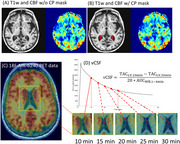 Figure 1
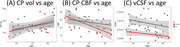 Figure 2
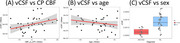 Figure 3
Peer Reviews
No public reviews on file for this paper yet. If you reviewed it on a platform where reviews are public (OpenReview, ICLR, NeurIPS, ICML), you can paste yours below so the community can read it here.
Videos
No videos yet. Explain this paper in a talk, walkthrough, or lecture? Add one.
Taxonomy
TopicsCerebrospinal fluid and hydrocephalus · Dementia and Cognitive Impairment Research · Cerebral Venous Sinus Thrombosis