Interchangeability of Centiloid values from different research and commercial software using [18F]flutemetamol PET images
Ariane Bollack, Christopher Buckley, Mark R Battle, Adam J. Schwarz, Oskar Hansson, Pierrick Bourgeat, Vincent Dore, Jurgen Fripp, Rachid Fahmi, Elena M Bonke, Lennart Thurfjell, William Balhorn, Mike Haas, Christopher Page, Gill Farrar

TL;DR
This study evaluates how consistent Centiloid values are across different software tools for analyzing amyloid PET scans, finding high agreement but some variability.
Contribution
The study provides a systematic comparison of multiple software pipelines for amyloid PET quantification using Centiloid values.
Findings
Test-retest variability was low with biases under 5 CL and repeatability coefficients between 8.1-16.1 CL.
High group-level agreement (R2≥0.93) was observed, but 95% limits of agreement ranged between 12-23 CL.
Dichotomization reliability was above 92% for most scans but lower near positivity thresholds.
Abstract
Amyloid PET quantification using the Centiloid (CL) metric is becoming more prevalent and may have a role in clinical decision‐making. But what is the intrinsic confidence interval around a given CL value? To what extent is a CL value from one pipeline equivalent to that from another? We systematically assessed repeatability, reproducibility, and reliability across seven CL quantification pipelines applied to 210 [18F]flutemetamol scans. Three datasets were used: (1) an AD test‐retest cohort (N = 10x2); (2) an amnestic MCI cohort (N = 80); (3) cases from the BioFINDER‐1 cohort enriched for amyloid loads around published positivity thresholds (0‐50CL) (N = 110). Three regulatory‐approved software (cPET, MIMneuro, syngo. MI Neurology) and four research pipelines (CapAIBL, rPOP, Amypype, SPM8) were evaluated. Dataset 1 was used to assess within‐subject repeatability. Dataset 2 was used to…
Genes, proteins, chemicals, diseases, species, mutations and cell lines named across the full text — each resolved to its canonical identifier and authoritative record.
Click any figure to enlarge with its caption.
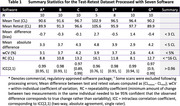 Figure 1
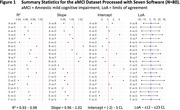 Figure 2
Peer Reviews
No public reviews on file for this paper yet. If you reviewed it on a platform where reviews are public (OpenReview, ICLR, NeurIPS, ICML), you can paste yours below so the community can read it here.
Videos
No videos yet. Explain this paper in a talk, walkthrough, or lecture? Add one.
Taxonomy
TopicsDementia and Cognitive Impairment Research · Intracerebral and Subarachnoid Hemorrhage Research · Alzheimer's disease research and treatments