From blood vessels to lymphatics and back again
Walter L. Murfee, Jerome W. Breslin

Abstract
Genes, proteins, chemicals, diseases, species, mutations and cell lines named across the full text — each resolved to its canonical identifier and authoritative record.
Click any figure to enlarge with its caption.
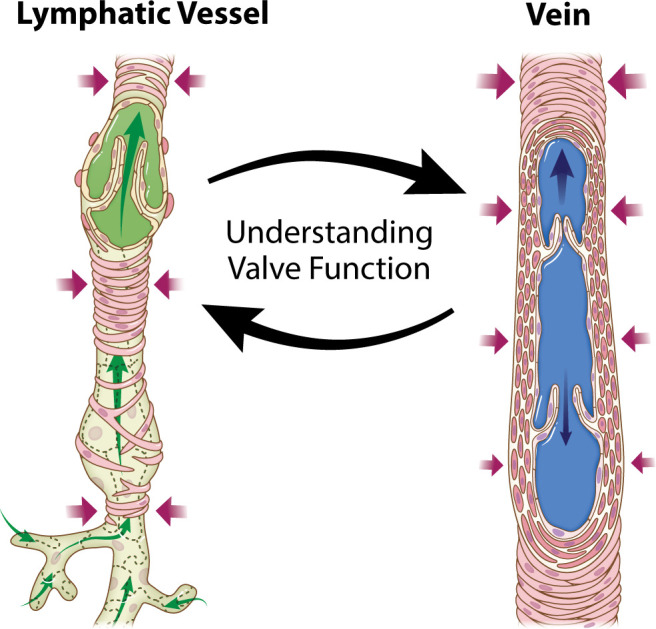 Figure 1
Peer Reviews
No public reviews on file for this paper yet. If you reviewed it on a platform where reviews are public (OpenReview, ICLR, NeurIPS, ICML), you can paste yours below so the community can read it here.
Videos
No videos yet. Explain this paper in a talk, walkthrough, or lecture? Add one.
Taxonomy
TopicsLymphatic System and Diseases · Lymphatic Disorders and Treatments · Cerebrospinal fluid and hydrocephalus
From blood vessels to lymphatics and back again—the path for fluid transport from the circulation, through the interstitial space, into lymphatic capillaries, and eventually back into large veins, in many ways parallels the impacts made by researchers during our careers. Recognizing the overlaps between both systems, leading vascular physiologists leveraged opportunities to apply methods, approaches, and a fundamental understanding to elucidate how lymphatic vessels work (1, 2). In this journal, Davis and King (3) provide a nice example of in turn applying what they have learned about lymphatic function to advance our understanding of how blood vessels work (Fig. 1). Based on servo-nulling micropipette pressure measurements in isolated veins from mice, the results implicate a causal relationship between venous tone and venous valve closure.
The work refreshingly extends methods used to describe pressure differences across valves in isolated lymphangions (4, 5) to link the contractile state of venous smooth muscle cells to venous valve leak. Scientific rigor is highlighted by a simple story based on technically challenging physiology methods, which are less common these days, probably due to the length of required training time and the juxtaposition with pace-driven pressures of academic research. The application of the old methods provokes new questions and reconsideration of what we know about venous smooth muscle cell constriction and venous valve function. How many valves are needed along veins? Are venous valves heterogenous? Does heterogeneity matter? Can rescuing venous tone improve venous valve function? Can the relationship between venous tone and valve function explain dysfunction associated with disease states? As Dr. Davis passes his servonulling systems to the next generation of vascular physiologists, maybe the most pressing question is—who will be measuring pressures?
The reference list from the paper itself. Each links out to its DOI / PubMed record.
- 1Breslin JW, Yang Y, Scallan JP, Sweat RS, Adderley SP, Murfee WL. Lymphatic vessel network structure and physiology. Compr Physiol 9: 207–299, 2018. doi:10.1002/cphy.c 180015. 30549020 PMC 6459625 · doi ↗ · pubmed ↗
- 2Lampejo AO, Jo M, Murfee WL, Breslin JW. The microvascular-lymphatic interface and tissue homeostasis: critical questions that challenge current understanding. J Vasc Res 59: 327–342, 2022. doi:10.1159/000525787. 36315992 PMC 9780194 · doi ↗ · pubmed ↗
- 3Davis MJ, King PD. Venous tone is a critical determinant of venous valve closure in the mouse. Function (Oxf) 6: zqaf 052, 2025. doi:10.1093/function/zqaf 052. 41183494 PMC 12658363 · doi ↗ · pubmed ↗
- 4Davis MJ, Castorena-Gonzalez JA, Li M, Simon AM, Srinivasan RS. Hierarchical requirement for endothelial cell connexins Cx 37, Cx 47, Cx 43 and Cx 45 in lymphatic valve function. Function (Oxf) 6: zqaf 034, 2025. doi:10.1093/function/zqaf 034. 40720769 PMC 12448487 · doi ↗ · pubmed ↗
- 5Davis MJ, Zawieja SD, Yang Y. Developmental progression of lymphatic valve morphology and function. Front Cell Dev Biol 12: 1331291, 2024. doi:10.3389/fcell.2024.1331291. 38450249 PMC 10915029 · doi ↗ · pubmed ↗