Cutaneous Chikungunya in a Nonfebrile Traveler to Madagascar
Naseem Alavian, Sofia Zavala, Robert Rolfe

Abstract
Click any figure to enlarge with its caption.
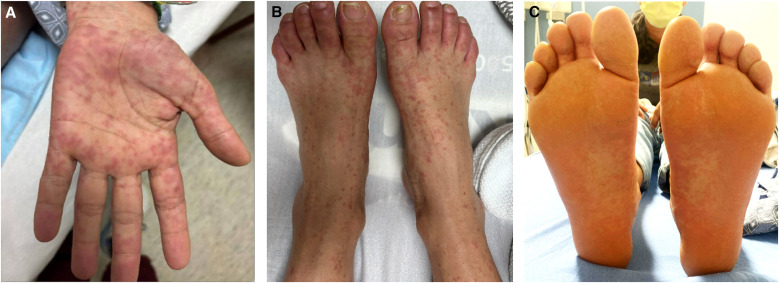 Figure 1
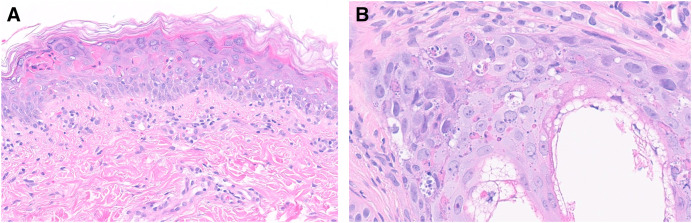 Figure 2
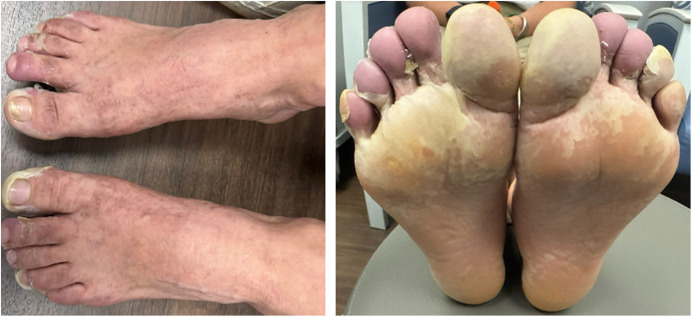 Figure 3
Peer Reviews
No public reviews on file for this paper yet. If you reviewed it on a platform where reviews are public (OpenReview, ICLR, NeurIPS, ICML), you can paste yours below so the community can read it here.
Videos
No videos yet. Explain this paper in a talk, walkthrough, or lecture? Add one.
Taxonomy
TopicsMosquito-borne diseases and control · Poxvirus research and outbreaks · Fungal Infections and Studies
A 33-year-old female developed a diffuse pruritic rash 2 weeks into a research trip to Madagascar involving direct contact with lemurs. The rash began on her legs and spread to extremities, trunk, and face. She reported paresthesias that made ambulation uncomfortable but denied fever, arthralgia, abdominal pain, or diarrhea. Her only medication was atovaquone/proguanil for malaria prophylaxis.
Multiple coalescent pink macules, some with dusky center and targetoid appearance were seen on face, trunk, and extremities on day 7 of illness (Figure 1A and B). Confluent erythema involved bilateral soles with bullae on dorsal toes (Figure 1C). A single aphthae-like lesion was seen on the lingual frenulum.
Punch biopsy was performed prior to infectious disease specialist consultation. Histopathology revealed numerous dyskeratotic keratinocytes at all epidermal levels, concentrated in the superficial epidermis, coalescing into superficial necrosis (Figure 2).
Chikungunya virus (CHIKV) IgM and IgG qualitative enzyme-linked immunosorbent assay testing were both positive on day 7 of illness. Treponema pallidum IgG, Dengue virus IgG/IgM and NS1 antigen, and Rocky Mountain spotted fever IgG were negative. The rash resolved over 4 weeks, with residual desquamation of the palms and soles at day 25 of illness (Figure 3).
Chikungunya is an arbovirus infection transmitted by Aedes mosquitoes, a vector that also transmits dengue, Zika, and yellow fever viruses.1 Fever and joint pains are generally predominant symptoms; however, a diverse range of cutaneous manifestations, including maculopapular rash, targetoid lesions, morbilliform rash, vesicles, bullae, and desquamation may occur.2 Recognition of these features, even in the absence of fever, is critical in returning travelers. In 2025, there have been outbreaks of chikungunya in countries in the Indian Ocean, including Madagascar.3 Madagascar is endemic for dengue as well but not known to be endemic for Zika.3 Climate change and increasing temperatures will likely contribute to expanded range of the vectors for CHIKV and other mosquito-borne arboviruses, with experts anticipating increase in autochthonous CHIKV transmission in North America.4^,^5
The reference list from the paper itself. Each links out to its DOI / PubMed record.
- 1Rolfe RJ Zavala S Blackwood ER La Rocque RC Ryan ET, 2025. Mosquito-borne infections in international travelers. Wilderness Environ Med 36: 572–585.40686432 10.1177/10806032251356485 · doi ↗ · pubmed ↗
- 2Oliveira JLD Nogueira IA Amaral JK Campos LR Mendonça MMM Ricarte MB Cavalcanti LPG Schoen RT, 2023. Extra-articular manifestations of Chikungunya. Rev Soc Bras Med Trop 56: 0341.38088664 10.1590/0037-8682-0341-2023 PMC 10706034 · doi ↗ · pubmed ↗
- 3US Centers for Disease Control and Prevention. 2025. Travelers’ Health Madagascar. Available at: https://wwwnc.cdc.gov/travel/destinations/traveler/none/madagascar. Accessed October 7, 2025.
- 4de Souza WM, , 2024. Chikungunya: A decade of burden in the Americas. Lancet Reg Health Am 30: 100673.38283942 10.1016/j.lana.2023.100673 PMC 10820659 · doi ↗ · pubmed ↗
- 5Delrieu M Martinet JPO’Connor O Viennet E Menkes C Burtet-Sarramegna V Frentiu FD Dupont-Rouzeyrol M, 2023. Temperature and transmission of chikungunya, dengue, and Zika viruses: A systematic review of experimental studies on Aedes aegypti and Aedes albopictus. Curr Res Parasitol Vector Borne Dis 4: 100139.37719233 10.1016/j.crpvbd.2023.100139 PMC 10500480 · doi ↗ · pubmed ↗