Absolute risk of cognitive impairment by AD amyloid stages
Mingzhao Hu

TL;DR
This study shows how amyloid levels in the brain predict the risk of cognitive decline over a lifetime, especially when combined with age and genetic factors.
Contribution
The study introduces a novel approach to assess lifetime cognitive impairment risk using amyloid PET stages and competing risks modeling.
Findings
Higher amyloid PET Centiloid levels strongly predict increased lifetime risk of MCI or dementia.
Amyloid stage effects surpass age effects for dementia risk but amplify age effects for MCI.
APOE4 carriers and males have elevated risks, but amyloid staging remains the strongest predictor.
Abstract
Despite advances in Alzheimer's disease (AD) research, limited information exists regarding the absolute risk of mild cognitive impairment (MCI) in cognitively unimpaired (CU) individuals with abnormal AD biomarkers, particularly when accounting for competing risks of death. This knowledge gap is critical as the field addresses disease‐modifying treatments targeting CU individuals with preclinical AD. We focus on the predictive value of AD amyloid stages defined by amyloid PET Centiloid values. We included 5,858 participants from the Mayo Clinic Study of Aging (MCSA) to evaluate AD amyloid stage as a predictor of clinical progression to MCI or dementia. The data includes long‐term follow‐up information on death and dementia beyond active study participation, which mitigates potential bias due to dropout. We predicted 10‐year and lifetime risks of MCI and dementia, accounting for the…
Genes, proteins, chemicals, diseases, species, mutations and cell lines named across the full text — each resolved to its canonical identifier and authoritative record.
Click any figure to enlarge with its caption.
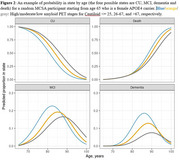 Figure 1
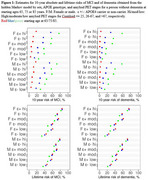 Figure 2
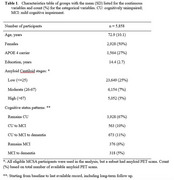 Figure 3
Peer Reviews
No public reviews on file for this paper yet. If you reviewed it on a platform where reviews are public (OpenReview, ICLR, NeurIPS, ICML), you can paste yours below so the community can read it here.
Videos
No videos yet. Explain this paper in a talk, walkthrough, or lecture? Add one.
Taxonomy
TopicsDementia and Cognitive Impairment Research · Alzheimer's disease research and treatments · Neurological Disease Mechanisms and Treatments