Identifying individual and organizational predictors of accidental exposure to blood (AEB) among hospital healthcare workers: A longitudinal study – ERRATUM
René Sosata Bun, Karim Aït Bouziad, Oumou Salama Daouda, Katiuska Miliani, Anastasia Eworo, Florence Espinasse, Delphine Seytre, Anne Casetta, Simone Nérome, Laura Temime, Mounia N. Hocine, Pascal Astagneau

Abstract
Genes, proteins, chemicals, diseases, species, mutations and cell lines named across the full text — each resolved to its canonical identifier and authoritative record.
Click any figure to enlarge with its caption.
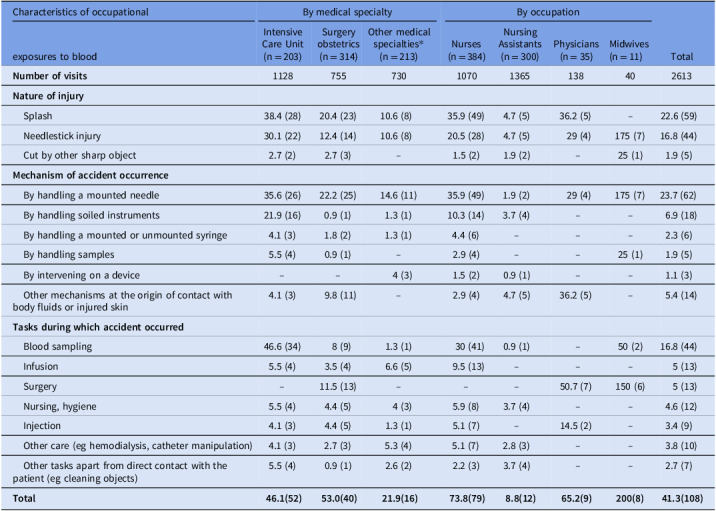 Figure 1
Peer Reviews
No public reviews on file for this paper yet. If you reviewed it on a platform where reviews are public (OpenReview, ICLR, NeurIPS, ICML), you can paste yours below so the community can read it here.
Videos
No videos yet. Explain this paper in a talk, walkthrough, or lecture? Add one.
Taxonomy
TopicsBlood donation and transfusion practices · Infection Control in Healthcare · Safe Handling of Antineoplastic Drugs
In this article,1 the column “Other medical specialties” was omitted from Table 1 due to an error that occurred during typesetting. The correct table appears below. The publisher apologizes for the error.
Table 1.Incidence rate of accidental exposure to blood per 1000 person-years by medical specialty and by occupation (n = 108)Characteristics of occupationalBy medical specialtyBy occupationexposures to bloodIntensive Care Unit (n = 203)Surgery obstetrics (n = 314)Other medical specialties* (n = 213)Nurses (n = 384)Nursing Assistants (n = 300)Physicians (n = 35)Midwives (n = 11)Total Number of visits 112875573010701365138402613 Nature of injury Splash38.4 (28)20.4 (23)10.6 (8)35.9 (49)4.7 (5)36.2 (5)–22.6 (59) Needlestick injury30.1 (22)12.4 (14)10.6 (8)20.5 (28)4.7 (5)29 (4)175 (7)16.8 (44) Cut by other sharp object2.7 (2)2.7 (3)–1.5 (2)1.9 (2)–25 (1)1.9 (5) Mechanism of accident occurrence By handling a mounted needle35.6 (26)22.2 (25)14.6 (11)35.9 (49)1.9 (2)29 (4)175 (7)23.7 (62) By handling soiled instruments21.9 (16)0.9 (1)1.3 (1)10.3 (14)3.7 (4)––6.9 (18) By handling a mounted or unmounted syringe4.1 (3)1.8 (2)1.3 (1)4.4 (6)–––2.3 (6) By handling samples5.5 (4)0.9 (1)–2.9 (4)––25 (1)1.9 (5) By intervening on a device––4 (3)1.5 (2)0.9 (1)––1.1 (3) Other mechanisms at the origin of contact with body fluids or injured skin4.1 (3)9.8 (11)–2.9 (4)4.7 (5)36.2 (5)–5.4 (14) Tasks during which accident occurred Blood sampling46.6 (34)8 (9)1.3 (1)30 (41)0.9 (1)–50 (2)16.8 (44) Infusion5.5 (4)3.5 (4)6.6 (5)9.5 (13)–––5 (13) Surgery–11.5 (13)–––50.7 (7)150 (6)5 (13) Nursing, hygiene5.5 (4)4.4 (5)4 (3)5.9 (8)3.7 (4)––4.6 (12) Injection4.1 (3)4.4 (5)1.3 (1)5.1 (7)–14.5 (2)–3.4 (9) Other care (eg hemodialysis, catheter manipulation)4.1 (3)2.7 (3)5.3 (4)5.1 (7)2.8 (3)––3.8 (10) Other tasks apart from direct contact with the patient (eg cleaning objects)5.5 (4)0.9 (1)2.6 (2)2.2 (3)3.7 (4)––2.7 (7) Total
46.1(52)
53.0(40)
21.9(16)
73.8(79)
8.8(12)
65.2(9)
200(8)
41.3(108) *Other medical specialties: cardiology, geriatrics, gastroenterology, infectious diseases, internal medicine, nephrology, oncology, pulmonology, rheumatology, urology. Indicence per 1000 person-years, the number of accident (n) is specified under brackets.
The reference list from the paper itself. Each links out to its DOI / PubMed record.
- 1Bun RS , Aït Bouziad K , Daouda OS , et al. Identifying individual and organizational predictors of accidental exposure to blood (AEB) among hospital healthcare workers: A longitudinal study. Infect Control Hosp Epidemiol 2024;45(4):491–500. doi: 10.1017/ice.2023.248 38086622 PMC 11007361 · doi ↗ · pubmed ↗