Evaluating Potentially Synergistic Effects of APOE‐ε4 and Vascular Risk Factors on White Matter Hyperintensity Burden
Cameron C Heyman, Erin E Cawston, Cameron Stolker, Tracy R Melzer, Campbell J Le Heron, Reece P Roberts, Ian J Kirk, Kiri L Brickell, John C Dalrymple‐Alford, Tim J Anderson, Nicholas J Cutfield, Catherine A Morgan, Lynette J Tippett

TL;DR
This study examines how the APOE-ε4 gene and vascular risk factors like hypertension affect white matter hyperintensity (WMH) burden in the brain, finding that they each contribute independently but not synergistically.
Contribution
The study provides new evidence that APOE-ε4 and hypertension independently increase WMH burden without a synergistic effect.
Findings
APOE-ε4 carriers had greater WMH volume compared to noncarriers (p = .025).
Hypertension was associated with increased WMH volume (p = .022).
APOE-ε4 did not interact synergistically with vascular risk factors to increase WMH burden.
Abstract
White matter hyperintensities (WMHs) observed on MRI are indicative of cerebral small vessel disease. WMHs are prevalent in ageing and might be more severe in the context of Alzheimer's disease (AD). Though genetic and vascular risk factors (VRFs) may play a role, whether these factors directly influence WMH burden is unclear. We investigated whether APOE‐ε4 and VRFs were each associated with greater WMH burden and then examined whether associations between VRFs and WMH burden were stronger in APOE‐ε4 carriers. Participants (n = 248) from New Zealand Dementia Prevention Research Clinics classified as control, subjective cognitive decline, amnestic single‐ or multiple‐domain mild cognitive impairment, or early AD‐dementia were included. APOE genotyping was performed on DNA from fasting bloods. A composite VRF, the Framingham Heart Study's cardiovascular risk score (FRS‐CVD) was…
Genes, proteins, chemicals, diseases, species, mutations and cell lines named across the full text — each resolved to its canonical identifier and authoritative record.
Click any figure to enlarge with its caption.
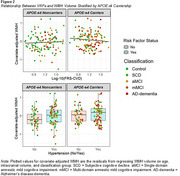 Figure 1
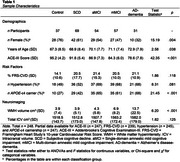 Figure 2
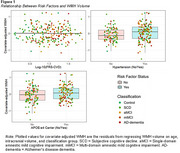 Figure 3
Peer Reviews
No public reviews on file for this paper yet. If you reviewed it on a platform where reviews are public (OpenReview, ICLR, NeurIPS, ICML), you can paste yours below so the community can read it here.
Videos
No videos yet. Explain this paper in a talk, walkthrough, or lecture? Add one.
Taxonomy
TopicsDementia and Cognitive Impairment Research · Alzheimer's disease research and treatments · Advanced MRI Techniques and Applications