Reactive Astrogliosis predicts Amyloid Accumulation before the Preclinical Stage of Alzheimer's Disease
Vincent Dore, Pierrick Bourgeat, Ryuichi Harada, Shozo Furumoto, Rachel S Mulligan, Ying Xia, Ishara Paranawithana, Simon M. Laws, Azadeh Feizpour, Svetlana Bozinovski, Kun Huang, Brian J Lopresti, Milos D. Ikonomovic, Jurgen Fripp, Nobuyuki Okamura, Christopher C. Rowe

TL;DR
This study shows that increased MAO-B tracer binding in reactive astrocytes can predict amyloid accumulation in Alzheimer's disease before symptoms appear.
Contribution
The study introduces 18F-SMBT-1 as a potential early prognostic marker for Alzheimer's by linking reactive astrogliosis to amyloid accumulation.
Findings
18F-SMBT-1 binding is higher in cognitively unimpaired individuals with preclinical Alzheimer's.
High 18F-SMBT-1 retention predicts faster amyloid accumulation in cognitively unimpaired individuals.
18F-SMBT-1 provides regional insights into reactive astrogliosis across Alzheimer's disease stages.
Abstract
Monoamine Oxidase‐B (MAO‐B) is overexpressed in reactive astrocytes, playing a crucial role in neurodegeneration. Recently, increased binding of the PET MAO‐B tracer 18F‐SMBT‐1 has been shown in preclinical Alzheimer's disease (AD) stages. However, the regional distribution and effect on Ab of abnormal 18F‐SMBT‐1 binding along the AD continuum remains unclear. 144 Cognitively Unimpaired (CU), 24 A+ Mild Cognitive Impairment (MCI), and 20 A+ AD subjects underwent PET imaging with 18F‐NAV4694, 18F‐MK6240, and 18F‐SMBT‐1. Aβ and tau PET SUVR were transformed into Centiloid (CL) and CenTauR (CTR) using CapAIBL. A+ was defined as >15CL and T+ >14 CTR in the Meta‐Temporal. SMBT‐1 scans were spatially normalised using MR‐based CapAIBL, scaled to the cerebellar cortex and several cortical regions sampled. The relationship between SMBT‐1 binding and Aβ accumulation was assessed in a subset of…
Genes, proteins, chemicals, diseases, species, mutations and cell lines named across the full text — each resolved to its canonical identifier and authoritative record.
Click any figure to enlarge with its caption.
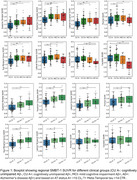 Figure 1
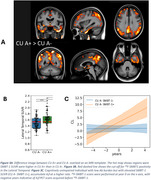 Figure 2
Peer Reviews
No public reviews on file for this paper yet. If you reviewed it on a platform where reviews are public (OpenReview, ICLR, NeurIPS, ICML), you can paste yours below so the community can read it here.
Videos
No videos yet. Explain this paper in a talk, walkthrough, or lecture? Add one.
Taxonomy
TopicsAlzheimer's disease research and treatments · Neuroscience and Neuropharmacology Research · Dementia and Cognitive Impairment Research