Determining the Impact of Voxel Size on the Clinical Utility of Quantitative Susceptibility Imaging in Multicenter Clinical Trials
Arvin Arani, Scott A. Przybelski, Bret J. Borowski, Matthew L. Senjem, Petrice M Cogswell, Prashanthi Vemuri, Kejal Kantarci, Clifford R. Jack

TL;DR
This study compares how different MRI voxel sizes affect susceptibility measurements in brain regions, finding strong agreement in iron-rich areas but differences in smaller regions.
Contribution
The study evaluates the clinical utility of different QSM voxel sizes in multicenter trials, revealing high correlation in key brain regions.
Findings
ADNI4 and CLARiTI protocols showed significant group differences in small surface regions but agreement in substantia nigra.
Strong correlation (r2 = 0.93) in susceptibility estimates for substantia nigra between protocols.
Differences in three small regions near air interfaces suggest resolution impacts accuracy in specific areas.
Abstract
T2*‐weighted imaging is of paramount importance for patient treatment eligibility and safety monitoring in anti‐amyloid pharmaceutical clinical trials and clinical care. Recently with the adoption of multi‐echo GRE (GRE) sequences, susceptibility weighted imaging (SWI), and quantitative susceptibility mapping (QSM) can be obtained in the same acquisition. In 2024, the QSM Consensus Organization Committee released a white paper recommending at least 1 mm isotropic voxel size for QSM. In clinical workflows microbleed detection is performed with higher in‐plane resolution (0.5x0.5mm2), and large out‐of‐plane resolution (∼1.8mm), which was used in the ADNI4 protocol. In the CLARiTI protocol, a 1mm isotropic resolution was adopted. The objective of this work was to compare susceptibility estimates between the ADNI4 (0.5x0.5x1.8mm3) and CLARiTI (1mm3) protocols. The ADNI4 and CLARiTI QSM…
Genes, proteins, chemicals, diseases, species, mutations and cell lines named across the full text — each resolved to its canonical identifier and authoritative record.
Click any figure to enlarge with its caption.
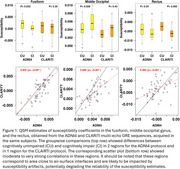 Figure 1
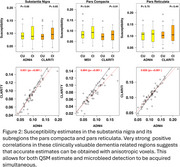 Figure 2
Peer Reviews
No public reviews on file for this paper yet. If you reviewed it on a platform where reviews are public (OpenReview, ICLR, NeurIPS, ICML), you can paste yours below so the community can read it here.
Videos
No videos yet. Explain this paper in a talk, walkthrough, or lecture? Add one.
Taxonomy
TopicsIntracerebral and Subarachnoid Hemorrhage Research · Dementia and Cognitive Impairment Research · Alzheimer's disease research and treatments