Community-based approach to detect and predict conflicts with large carnivores in human-dominated landscape
Izabela Fedyń, Marek Pasiniewicz, Katarzyna Zabiega, Hubert Fedyń, Michał Ciach

TL;DR
This study uses community reports to understand and predict conflicts between large carnivores and humans in the Carpathians.
Contribution
The study introduces a community-based approach to monitor and predict carnivore conflicts using local observations.
Findings
Bears and wolves were recorded in 6% and 12% of built-up areas in the Carpathians.
Carnivores interacted with anthropogenic food resources in 53% of reports.
Community involvement improves early conflict detection and coexistence strategies.
Abstract
Understanding context-specific drivers and mechanisms of human-wildlife interactions is crucial to designing effective conservation strategies. Community-based data provides valuable insights for adaptive management efforts aimed at fostering coexistence in shared landscapes. This study analyzed 611 reports of grey wolves and brown bears recorded by rural communities in the Carpathians (Poland). Bears and wolves were recorded in 6% and 12% of all built-up areas within the study region, respectively. These species exploited anthropogenic food resources (53% of all reports), interacting with pets, livestock, and wild animals found within human settlements. The probability of carnivore reports increased with the number of previous observations and was influenced by prior successful food acquisition. The observed pattern highlights the importance of habituation and food conditioning for…
Genes, proteins, chemicals, diseases, species, mutations and cell lines named across the full text — each resolved to its canonical identifier and authoritative record.
Click any figure to enlarge with its caption.
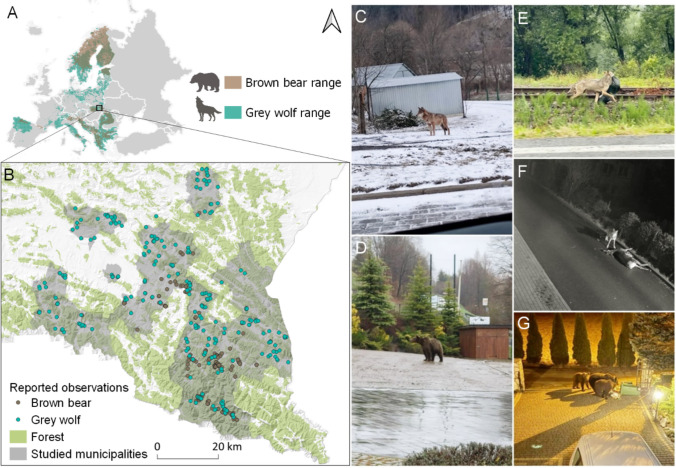 Figure 1
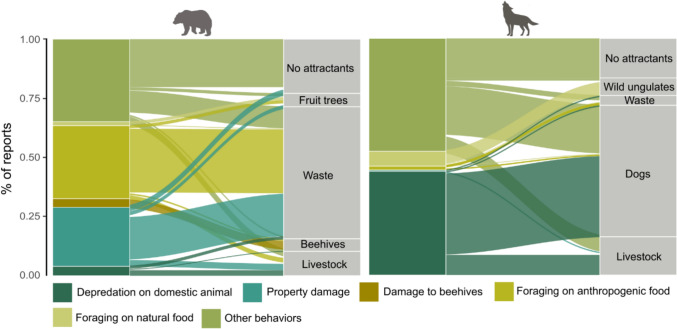 Figure 2
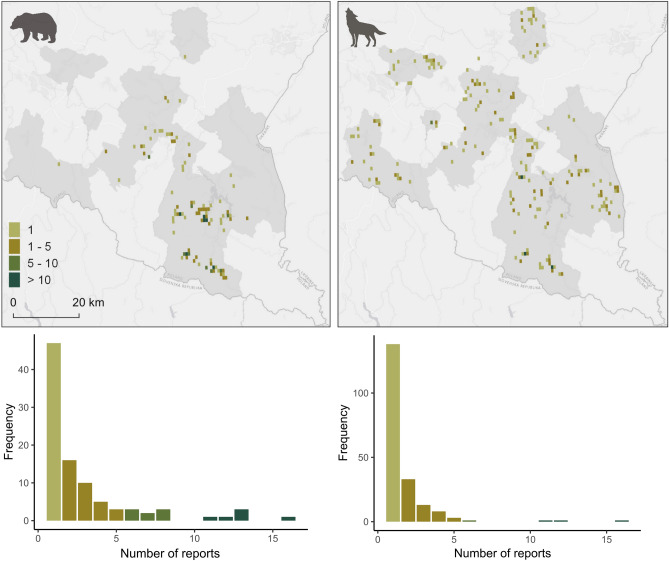 Figure 3
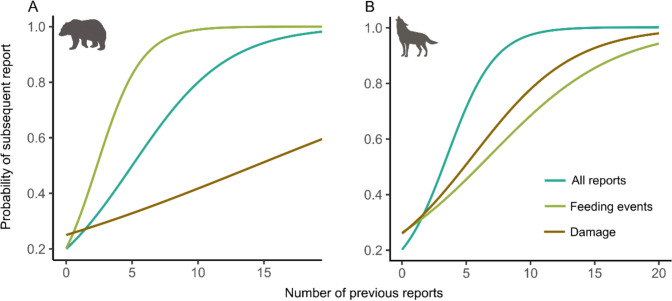 Figure 4
Peer Reviews
No public reviews on file for this paper yet. If you reviewed it on a platform where reviews are public (OpenReview, ICLR, NeurIPS, ICML), you can paste yours below so the community can read it here.
Videos
No videos yet. Explain this paper in a talk, walkthrough, or lecture? Add one.
Taxonomy
TopicsWildlife Ecology and Conservation · Ecology and biodiversity studies · Geographies of human-animal interactions