The Long‐Term Follow‐Up TIPP Project: LOFT Study Protocol, a 20‐Year Prospective Study of Early Psychosis Patients
Teya Petrova, Philippe Golay, Paul Klauser, Sandra Vieira, Inès Lepreux, Lora Bici, Boshra Razavi, Raoul Jenni, Nadir Mebdouhi, Martine Cleusix, Caroline Conchon, Lilith Abrahamyan Empson, Philippe Conus, Luis Alameda

TL;DR
This study tracks patients with early psychosis for 20 years to understand long-term health and neurobiological outcomes of early intervention.
Contribution
The study introduces a 20-year longitudinal protocol to assess long-term effects of early psychosis treatment and neurobiological evolution.
Findings
LOFT will evaluate physical, mental, and neurobiological outcomes over two decades.
Participants will be followed every 5 years with assessments on health and cognition.
A subsample will undergo additional biomarker and brain imaging assessments.
Abstract
Early intervention services (EIS) in psychosis are the gold standard to treat patients after a first episode of psychosis (FEP). However, the understanding of the evolution and the long‐term effects of such type of intervention is limited. This study aims to gain insight into the long‐term evolution of physical and mental health, as well as the neurobiological outcomes of the patients treated for a FEP. The Long‐term Follow‐up of TIPP (LOFT) is an up to 20‐year study within a cohort of patients who completed a three‐year EI treatment at Treatment and early Intervention in Psychosis Program (TIPP, in Lausanne, Switzerland) and went through a deep phenotyping prospective multimodal assessment. 720 patients will be contacted and asked to participate in LOFT. Once they are assessed they will be allocated to a timepoint at either 5 (+2), 10 (±2), 15 (±2), and 20 (−2) years after TIPP entry.…
Genes, proteins, chemicals, diseases, species, mutations and cell lines named across the full text — each resolved to its canonical identifier and authoritative record.
Click any figure to enlarge with its caption.
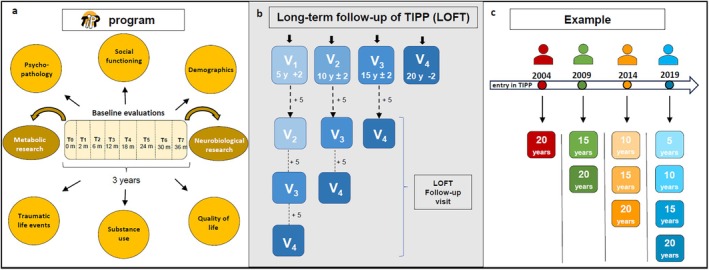 Figure 1
 Figure 2
Peer Reviews
No public reviews on file for this paper yet. If you reviewed it on a platform where reviews are public (OpenReview, ICLR, NeurIPS, ICML), you can paste yours below so the community can read it here.
Videos
No videos yet. Explain this paper in a talk, walkthrough, or lecture? Add one.
Taxonomy
TopicsSchizophrenia research and treatment · Mental Health and Psychiatry · Digital Mental Health Interventions