Revealing Structural Brain-Cognition Relationships in Children: A Comparison of Morphometric Similarity and INverse Divergence Networks
Shuning Han, Hao Jia, Gemma Vilaseca, Núria Vilaró, Feng Duan, Zhe Sun, Cesar F. Caiafa, Jordi Solé-Casals

TL;DR
This study compares two brain network methods in children to understand how brain structure relates to cognitive performance.
Contribution
The paper provides a novel comparison of morphometric similarity and inverse divergence networks in capturing brain-cognition relationships in children.
Findings
A connection density of p=0.05–0.15 optimizes network stability and cognitive correlations in both MSN and MIND.
MSN networks show more stable associations with cognitive performance across connection densities and hemispheric dimensions.
Higher cognitive performance correlates with stronger left intra-hemispheric connectivity and more modular organization.
Abstract
The study of structural brain networks (SBNs) offers critical insights into brain-cognition relationships. However, a comprehensive comparison of these methods in terms of their topological properties, cognitive relevance, and sensitivity to connection density remains lacking. This study compares two types of individual-level SBNs–morphometric similarity networks (MSNs) and morphometric inverse divergence (MIND) networks–by analyzing their associations with cognitive performance using sMRI data from 29 male children. Group- and individual-level analyses were conducted to evaluate differences in hemispheric connectivity, topological features, and their correlations with cognitive performance across different connection densities. In our analyses, a connection density of \documentclass[12pt]{minimal} \usepackage{amsmath} \usepackage{wasysym} \usepackage{amsfonts}…
Genes, proteins, chemicals, diseases, species, mutations and cell lines named across the full text — each resolved to its canonical identifier and authoritative record.
Click any figure to enlarge with its caption.
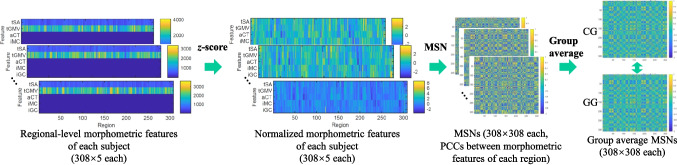 Figure 1
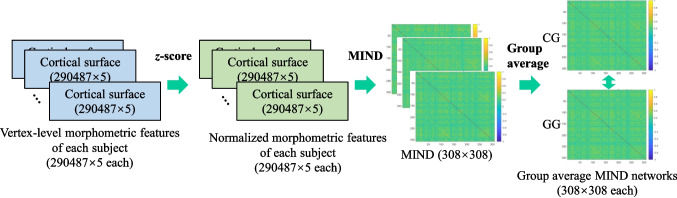 Figure 2
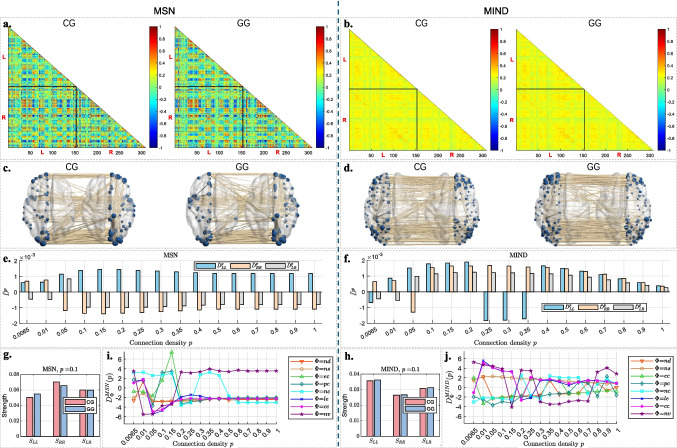 Figure 3
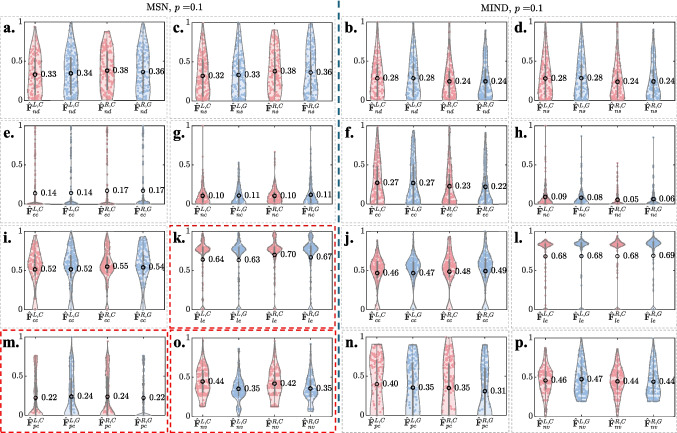 Figure 4
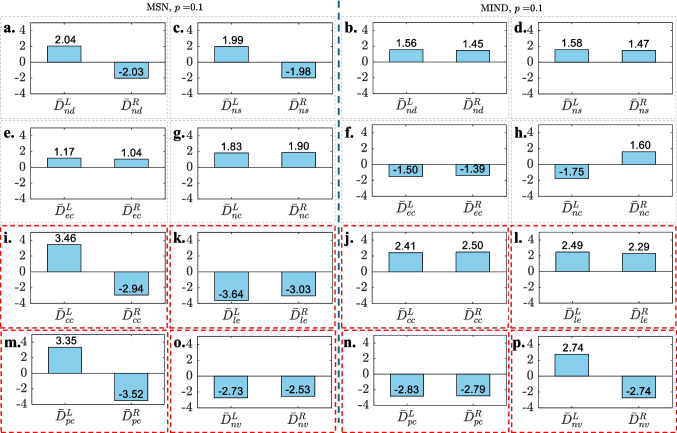 Figure 5
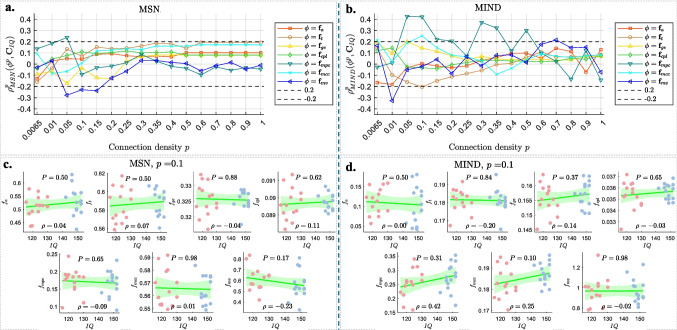 Figure 6
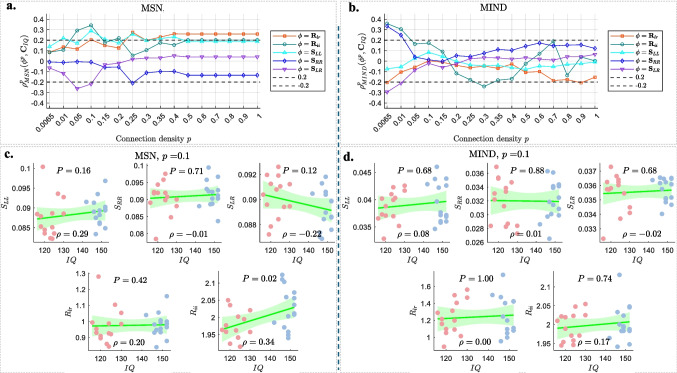 Figure 7
Peer Reviews
No public reviews on file for this paper yet. If you reviewed it on a platform where reviews are public (OpenReview, ICLR, NeurIPS, ICML), you can paste yours below so the community can read it here.
Videos
No videos yet. Explain this paper in a talk, walkthrough, or lecture? Add one.
Taxonomy
TopicsFunctional Brain Connectivity Studies · Face Recognition and Perception · Advanced Neuroimaging Techniques and Applications