Challenging the myth: comparing early complications of native and periprosthetic distal femur fractures. The role of implant stability
Christopher Lampert, Leon Faust, Gautier Beckers, Adrian Cavalcanti Kußmaul, Boris Michael Holzapfel, Wolfgang Böcker, Carl Neuerburg, Florian Pachmann

TL;DR
This study compares the treatment outcomes of native and periprosthetic distal femur fractures, finding that periprosthetic fractures are not necessarily more complex or problematic than native ones.
Contribution
The study directly compares periprosthetic and native distal femur fractures using the Lewis–Rorabeck classification to assess implant stability and early complications.
Findings
Periprosthetic fractures had lower complication rates compared to native fractures.
Lewis–Rorabeck Type III fractures required more revision surgeries and had longer time to surgery.
No significant differences were found in mobility or hospital stay between native and periprosthetic fractures.
Abstract
Periprosthetic distal femur fractures are often considered more complex and morbid than native distal femur fractures, yet few studies directly compare them. This study aimed to compare patient characteristics, treatment strategies, and early complications between native and periprosthetic distal femur fractures using the Lewis–Rorabeck classification. We retrospectively analyzed 152 patients treated surgically for distal femur fractures at a level I trauma center. Cases included native fractures (n = 90) and periprosthetic distal femur fractures (n = 62), further divided into Lewis–Rorabeck Type I/II (n = 49) and Type III (n = 13). Demographics, comorbidities, surgical details, and in-hospital complications were assessed. We conducted a multivariate analysis comparing native fractures with Lewis–Rorabeck Type I/II fractures, as well as comparing Type I/II with Type III fractures.…
Genes, proteins, chemicals, diseases, species, mutations and cell lines named across the full text — each resolved to its canonical identifier and authoritative record.
Click any figure to enlarge with its caption.
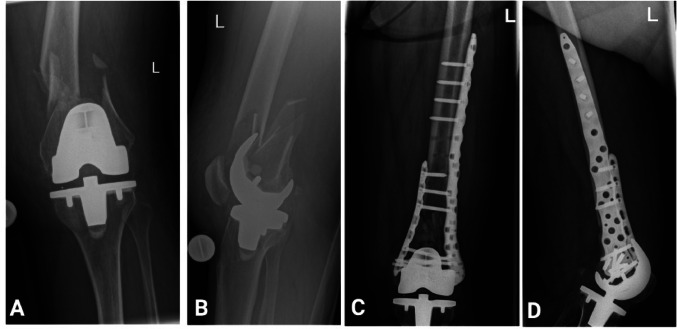 Figure 1
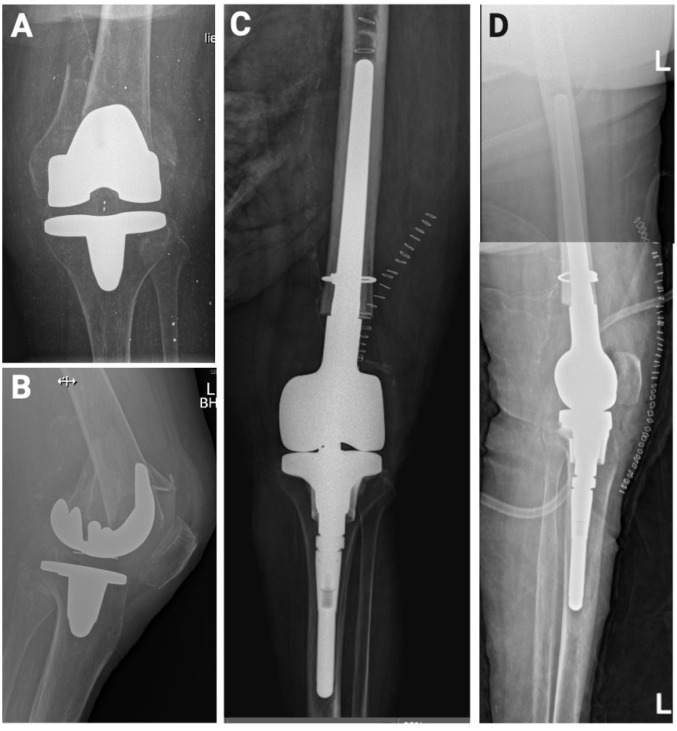 Figure 2
Peer Reviews
No public reviews on file for this paper yet. If you reviewed it on a platform where reviews are public (OpenReview, ICLR, NeurIPS, ICML), you can paste yours below so the community can read it here.
Videos
No videos yet. Explain this paper in a talk, walkthrough, or lecture? Add one.
Taxonomy
TopicsBone fractures and treatments · Orthopaedic implants and arthroplasty · Hip and Femur Fractures