Tau‐PET and plasma GFAP association in cognitively unimpaired Aβ‐PET negative individuals
Pampa Saha, Bruna Bellaver, Guilherme Povala, Pamela C.L. Ferreira, Guilherme Bauer‐Negrini, Livia Amaral, Firoza Z Lussier, Thomas K Karikari, Matheus Scarpatto Rodrigues, Markley Silva Oliveira, Andreia Rocha, Cynthia Felix, Emma Ruppert, Marina Scop Medeiros, Carolina Soares

TL;DR
This study finds a link between plasma GFAP levels and tau PET uptake in people without detectable Aβ pathology, suggesting astrocyte reactivity may influence tau pathology.
Contribution
The study is the first to show a GFAP-tau PET association in Aβ-negative, cognitively unimpaired individuals.
Findings
Plasma GFAP levels are associated with tau PET uptake in the medial temporal lobe in Aβ-negative individuals.
The association is stronger for Flortaucipir compared to MK6240 tau PET tracers.
Plasma p-tau217 shows a weak association with tau PET in Aβ-negative individuals.
Abstract
We showed that astrocyte reactivity, as measured by plasma GFAP levels, influences Aβ mediated tau PET pathology in cognitively unimpaired (CU) Aβ‐positive individuals. However, the link between GFAP and tau PET in individuals without detectable Aβ pathology remains elusive. The aim of the current study is to investigate the association between plasma GFAP and tau PET in CU Aβ PET‐negative individuals. We studied 147 CU Aβ PET‐negative participants from the HEAD cohort with plasma GFAP and p‐tau217, as well as tau PET Flortaucipir and MK6240 data. Aβ positivity was determined by Aβ PET visual reading and Centiloid 12. Voxel‐wise linear regression models adjusted for age and sex tested the association of plasma GFAP and p‐tau217 with tau PET. Further, the associations of plasma GFAP with peak tau PET SUVR values extracted from voxel‐wise association were fitted with a linear regression…
Genes, proteins, chemicals, diseases, species, mutations and cell lines named across the full text — each resolved to its canonical identifier and authoritative record.
Click any figure to enlarge with its caption.
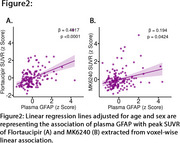 Figure 1
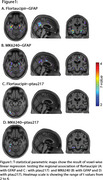 Figure 2
Peer Reviews
No public reviews on file for this paper yet. If you reviewed it on a platform where reviews are public (OpenReview, ICLR, NeurIPS, ICML), you can paste yours below so the community can read it here.
Videos
No videos yet. Explain this paper in a talk, walkthrough, or lecture? Add one.
Taxonomy
TopicsDementia and Cognitive Impairment Research · Neuroscience and Neuropharmacology Research · Medical Imaging Techniques and Applications