Investigating hippocampal hyperexcitability as a biomarker of Alzheimer's disease
Casey R Vanderlip, Jenna N. Adams

TL;DR
This study explores whether increased brain activity in the hippocampus, called hyperexcitability, can serve as a new biomarker for Alzheimer's disease, beyond existing markers.
Contribution
The study introduces hippocampal amplitude of low-frequency fluctuations (ALFF) as a novel biomarker of Alzheimer's disease progression.
Findings
Hippocampal ALFF was elevated in individuals with mild cognitive impairment compared to cognitively normal individuals.
Higher hippocampal ALFF correlated with increased tau pathology in individuals with amyloid-beta accumulation.
Adding hippocampal ALFF to existing biomarker models improved diagnostic accuracy for Alzheimer's disease.
Abstract
Hippocampal hyperexcitability is an early feature of Alzheimer's disease (AD) that may drive pathology. However, current models of AD risk focusing on the A/T/N framework (Aβ /Tau/Neurodegeneration) do not include hyperexcitability as a key disease biomarker. Here, we investigated a candidate hyperexcitability (“H”) biomarker from resting‐state fMRI (rsfMRI) ‐ the amplitude of low‐frequency fluctuations (ALFF), which reflects the intensity of spontaneous brain activity – to determine if it provides sensitive information about AD progression. We analyzed 386 older adults spanning the AD spectrum (277 cognitively normal, CN; 84 Aβ+ mild cognitive impairment, MCI; 25 Aβ+ AD dementia) from ADNI who underwent rsfMRI, Aβ‐PET (18F‐FBP/18F‐FBB), and tau‐PET (18F‐FTP) within a year. ALFF was quantified from rsfMRI in the hippocampus as the primary “H” candidate, as well as the retrosplenial…
Genes, proteins, chemicals, diseases, species, mutations and cell lines named across the full text — each resolved to its canonical identifier and authoritative record.
Click any figure to enlarge with its caption.
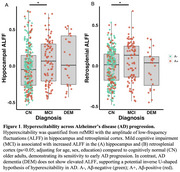 Figure 1
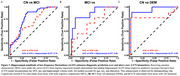 Figure 2
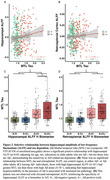 Figure 3
Peer Reviews
No public reviews on file for this paper yet. If you reviewed it on a platform where reviews are public (OpenReview, ICLR, NeurIPS, ICML), you can paste yours below so the community can read it here.
Videos
No videos yet. Explain this paper in a talk, walkthrough, or lecture? Add one.
Taxonomy
TopicsFunctional Brain Connectivity Studies · Dementia and Cognitive Impairment Research · Neuroscience and Neuropharmacology Research