CenTauR correlation with amyloid, atrophy and cognition across the Alzheimer's Disease spectrum: A tau imaging study with 18F‐MK6240 PET
Christopher C. Rowe, Azadeh Feizpour, Pierrick Bourgeat, Antoine Leuzy, Rachel S Mulligan, Joanne Robertson, Simon M. Laws, Ralph N Martins, Paul Maruff, Colin L Masters, Jurgen Fripp, Victor L. Villemagne, Vincent Dore

TL;DR
This study uses tau PET imaging to determine how tau levels in different brain regions relate to amyloid, brain atrophy, and cognitive decline in Alzheimer's disease.
Contribution
The study introduces regional CTR thresholds for tau and clarifies the relationship between tau distribution and Alzheimer's disease progression.
Findings
Cortical tau is rarely found below 60 Centiloid units of amyloid.
Cortical tau strongly correlates with cognitive impairment and brain atrophy.
Tau limited to the MTL is linked to mild memory impairment but not broader cognitive decline.
Abstract
The CenTauR (CTR) standard method for PET measurement of tau provides consistent results across tau tracers. This study establishes regional CTR thresholds for elevated tau and evaluates the CTR relationship with amyloid, neurodegeneration and cognition across the AD spectrum. 924 participants from the AIBL‐ADNeT study (448 cognitively unimpaired (CU), 300 MCI, 176 clinical AD), underwent 18F‐MK6240 tau PET, 18F‐NAV4694 Aβ PET, MRI and cognitive evaluations. We examined the relationship between global and regional tau quantification using the CTR method, and global Aβ (Centiloid), brain atrophy and cognition. From tau scans in A‐ (<25 CL) CU, 2 SD thresholds were 11 CTR in the mesial temporal lobe (MTL) and 15 CTR in the Temporo‐Parietal (TP) cortex. There was a non‐linear relationship between Aβ and tau with cortical tau rare below 60 CL (Figure 1). In clinical AD, 71% had A+ and…
Genes, proteins, chemicals, diseases, species, mutations and cell lines named across the full text — each resolved to its canonical identifier and authoritative record.
Click any figure to enlarge with its caption.
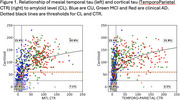 Figure 1
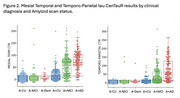 Figure 2
Peer Reviews
No public reviews on file for this paper yet. If you reviewed it on a platform where reviews are public (OpenReview, ICLR, NeurIPS, ICML), you can paste yours below so the community can read it here.
Videos
No videos yet. Explain this paper in a talk, walkthrough, or lecture? Add one.
Taxonomy
TopicsDementia and Cognitive Impairment Research · Alzheimer's disease research and treatments · Functional Brain Connectivity Studies