Predictive Processing Over the Course of Aging: Multiple Timescales of Effective Connectivity
Martin Tom Banaschewski, Christoph Mathys, István Winkler, Juanita Todd, Ryszard Auksztulewicz

TL;DR
This study explores how aging affects the brain's ability to adapt to changing sounds over time, using EEG and modeling to track neural connections.
Contribution
The paper reveals age-related changes in multi-timescale neural adaptation during predictive auditory processing for the first time.
Findings
ERPs showed stronger responses to original deviants than reverse deviants, with amplitudes increasing on short timescales but declining over longer timescales and with age.
Dynamic causal modeling revealed increased descending connectivity for original deviants and timescale-dependent intrinsic connectivity changes.
Aging was linked to stronger descending connectivity modulation by deviant type but weaker modulation by slow dynamics.
Abstract
Predictive processing theories describe perception as a dynamic interplay between top‐down predictions and bottom‐up prediction errors across hierarchical stages of sensory processing. However, it remains unclear how neural connectivity flexibly adapts to changing sensory environments over time, and how these dynamics are influenced by aging. This study investigated how temporal factors on three distinct timescales, as well as age, shape neural responses and connectivity to dynamically changing auditory stimuli. Electroencephalography (EEG) data were recorded from 63 participants aged 18–75 as they listened to sequences of tones, where rare and unexpected “original deviants” became standards over time, and previously standard tones became “reverse deviants.” Event‐related potentials (ERPs) were more pronounced for original deviants than reverse deviants. Amplitudes increased on short…
Genes, proteins, chemicals, diseases, species, mutations and cell lines named across the full text — each resolved to its canonical identifier and authoritative record.
Click any figure to enlarge with its caption.
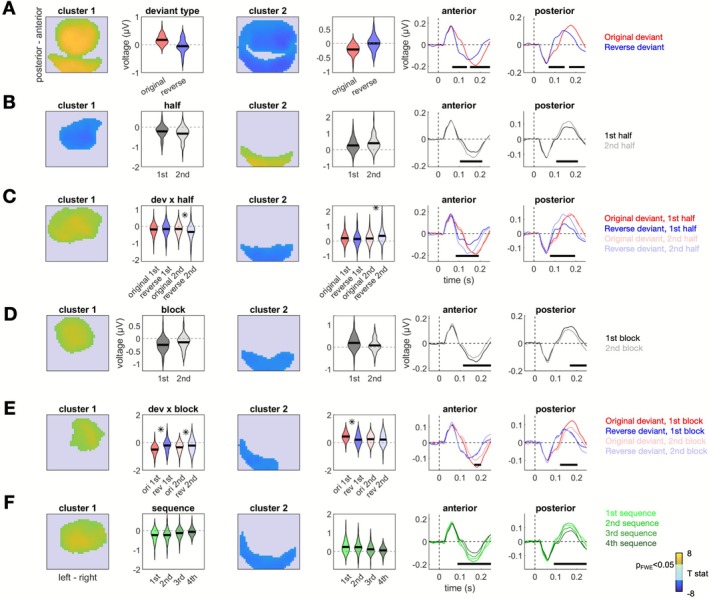 Figure 1
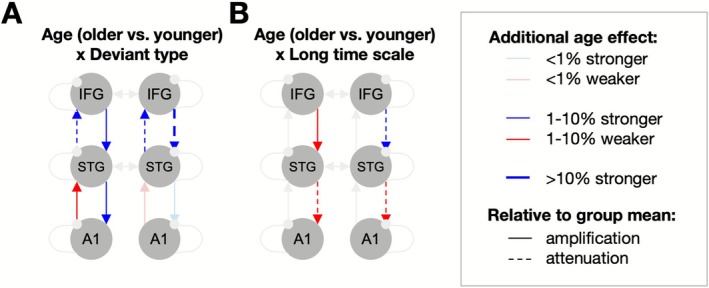 Figure 2
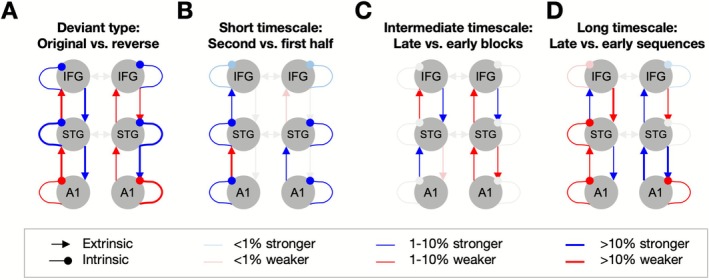 Figure 3
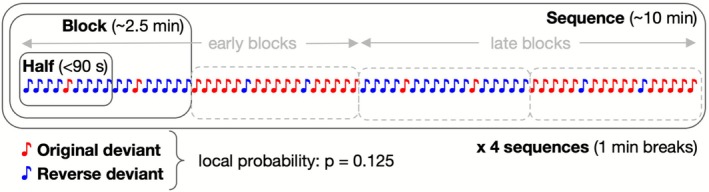 Figure 4
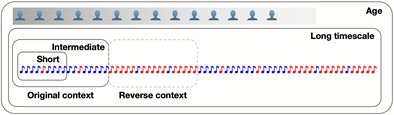 Figure 5
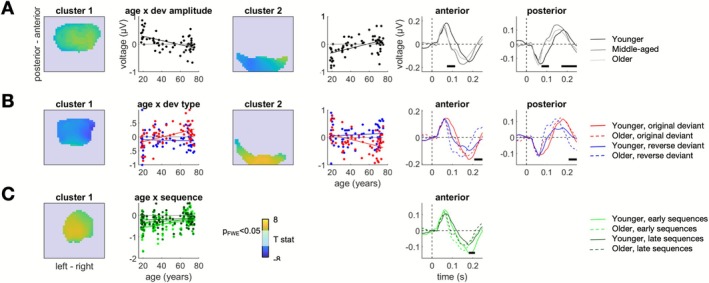 Figure 6
Peer Reviews
No public reviews on file for this paper yet. If you reviewed it on a platform where reviews are public (OpenReview, ICLR, NeurIPS, ICML), you can paste yours below so the community can read it here.
Videos
No videos yet. Explain this paper in a talk, walkthrough, or lecture? Add one.
Taxonomy
TopicsNeuroscience and Music Perception · Neural and Behavioral Psychology Studies · Functional Brain Connectivity Studies