Diagnostic yield of blood cultures in febrile neutropenia—a real-world observational study from an academic medical center during blood culture bottle shortage
Yuanli Lei, Maria Alkozah, Rita Wilson Dib, Bibi Maryam, Brandon Mohler, Emily A. Siegrist, Joseph Sassine

TL;DR
This study examined how effective blood cultures are for diagnosing infections in patients with febrile neutropenia during a shortage of blood culture bottles.
Contribution
The study provides real-world evidence on blood culture yield during shortages and suggests limiting repeat cultures within 48 hours.
Findings
The detection rate of true bacteremia increased with more blood culture sets, though not significantly.
Findings suggest avoiding repeat blood cultures within 48 hours to optimize resource use during shortages.
Abstract
This single-center retrospective analysis evaluated the yield of blood cultures in patients with febrile neutropenia during a supply shortage. The detection rate of true bacteremia was observed to increase with the number of sets obtained, although this increase was not statistically significant. Findings support limiting repeat cultures within 48 hours.
Genes, proteins, chemicals, diseases, species, mutations and cell lines named across the full text — each resolved to its canonical identifier and authoritative record.
Click any figure to enlarge with its caption.
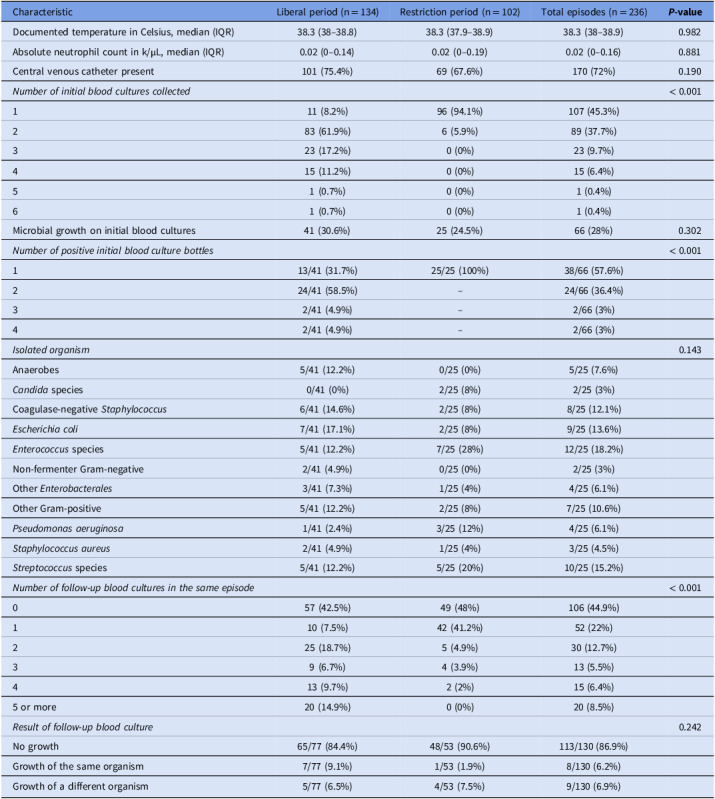 Figure 1
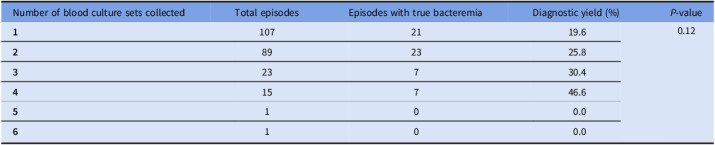 Figure 2
Peer Reviews
No public reviews on file for this paper yet. If you reviewed it on a platform where reviews are public (OpenReview, ICLR, NeurIPS, ICML), you can paste yours below so the community can read it here.
Videos
No videos yet. Explain this paper in a talk, walkthrough, or lecture? Add one.
Taxonomy
TopicsBacterial Identification and Susceptibility Testing · Neutropenia and Cancer Infections · Hematological disorders and diagnostics