Accelerated Phenotypical Aging in Midlife is Associated with Long‐Term Cognitive Decline in Middle‐Aged Adults
Natascha Merten, Mary Ryan Baumann, Adam J Paulsen, Huan Li, Richard J. Chappell, Yanjun Chen, Lindsay R Clark, Sterling C Johnson, James S Pankow, Art Walaszek, Madeleine G Soss

TL;DR
This study shows that people whose bodies appear biologically older than their actual age in midlife experience faster cognitive decline over the next decade.
Contribution
The study demonstrates a novel link between accelerated biological aging (PhenoAge) and long-term cognitive decline in middle-aged adults.
Findings
Higher PhenoAge in midlife is associated with worse cognitive performance at baseline.
Accelerated PhenoAge predicts faster cognitive decline over 10 years, especially in men.
PhenoAge may serve as a cost-effective early marker for cognitive impairment and dementia.
Abstract
PhenoAge is a multi‐system blood‐based aging marker that uses common clinical tests of glucose metabolism, inflammation and kidney and liver function. This easily‐obtained marker determines whether a person is younger or older on a biological and physiological level than expected by their chronological age. A higher PhenoAge is associated with increased risk of disability, age‐related morbidities and all‐cause mortality. Its associations with early cognitive changes in midlife is less understood. The aim of this study was to determine whether accelerated PhenoAge in midlife was associated with 10‐year cognitive changes in middle‐aged to older adults. This longitudinal study is based on N = 2,630 (54% women; mean age 50 years;Table 1) Beaver Dam Offspring Study (BOSS) participants. We measured baseline blood‐based clinical markers of health necessary for calculation of PhenoAge and…
Genes, proteins, chemicals, diseases, species, mutations and cell lines named across the full text — each resolved to its canonical identifier and authoritative record.
Click any figure to enlarge with its caption.
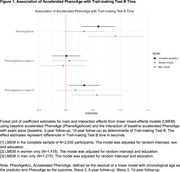 Figure 1
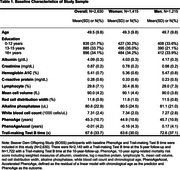 Figure 2
Peer Reviews
No public reviews on file for this paper yet. If you reviewed it on a platform where reviews are public (OpenReview, ICLR, NeurIPS, ICML), you can paste yours below so the community can read it here.
Videos
No videos yet. Explain this paper in a talk, walkthrough, or lecture? Add one.
Taxonomy
TopicsDementia and Cognitive Impairment Research · Genetics, Aging, and Longevity in Model Organisms · Frailty in Older Adults