Neuroinflammation and Amyloid deposition are independently associated with white matter hyperintensity burden in AD/VCID
Inema E Orukari, Yujie Wang, Yasheng Chen, Biwen Wang, Karl A. Friedrichsen, Shaney Flores, Ying Hwey Nai, Lynne A Jones, Farzaneh Rahmani, Jude‐Patrick Nnamdi Okafor, Jayashree Rajamanickam, Jin‐Moo Lee, Andria L Ford, Matthew R Brier, Zhude Tu, Tammie L.S. Benzinger, Hongyu An

TL;DR
The study finds that neuroinflammation and amyloid-beta are independently linked to white matter hyperintensities in Alzheimer's and vascular cognitive impairment.
Contribution
A novel PET probe [11C]CS1P1 is used to show independent associations of neuroinflammation and amyloid with white matter hyperintensities.
Findings
[11C]CS1P1 VT in the WMH ROI significantly correlates with WMH burden.
Both [11C]CS1P1 and PiB Centiloid are independently associated with WMH burden after controlling for covariates.
Abstract
White matter hyperintensities (WMHs) are associated with both Alzheimer's Disease (AD) and vascular contributions to cognitive impairment & dementia (VCID). Both neuroinflammation and amyloid‐β are hypothesized to contribute to WMH development, yet exact mechanisms are unknown. We have developed [11C]CS1P1, a novel PET probe targeting the S1PR1 receptor in the brain, a receptor which has been previously associated with neuroinflammation. In this study, we characterized [11C]CS1P1 PET and PiB Centiloid in human subjects with early AD/VCID. We enrolled 23 subjects (≥50 years old) with varying numbers of cerebrovascular risk factors (i.e. hypertension, hyperlipidemia, diabetes, stroke, and tobacco use), and had a CDR ≤0.5. Subjects had MPRAGE MRI scans for anatomic segmentation; FLAIR MRI scans for segmentation of WMHs; [11C]CS1P1 dynamic PET scans for quantifying S1PR1 activity (Figure…
Genes, proteins, chemicals, diseases, species, mutations and cell lines named across the full text — each resolved to its canonical identifier and authoritative record.
Click any figure to enlarge with its caption.
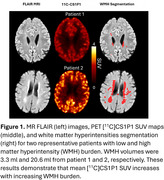 Figure 1
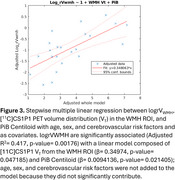 Figure 2
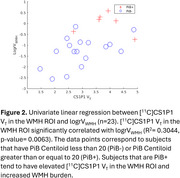 Figure 3
Peer Reviews
No public reviews on file for this paper yet. If you reviewed it on a platform where reviews are public (OpenReview, ICLR, NeurIPS, ICML), you can paste yours below so the community can read it here.
Videos
No videos yet. Explain this paper in a talk, walkthrough, or lecture? Add one.
Taxonomy
TopicsDementia and Cognitive Impairment Research · Alzheimer's disease research and treatments · Neurological Disease Mechanisms and Treatments