Transforming Pediatric Urology With Artificial Intelligence: A Narrative Review of Current Evidence and Practice
Muhammad Rakib Hasan, Angelos Christofides, Pradip Subedi, Momen Abdelglil, Alaa Alghanemi, Kawthar Shehab

TL;DR
Artificial intelligence is improving pediatric urology by enhancing diagnosis, surgery, and monitoring, though challenges like data scarcity remain.
Contribution
This paper reviews current AI applications in pediatric urology and highlights opportunities for future development.
Findings
AI improves hydronephrosis grading and obstruction prediction using deep learning models.
AI reduces subjectivity in diagnosing penile anomalies like hypospadias through image analysis.
Machine learning helps in risk-stratifying vesicoureteral reflux patients for better treatment planning.
Abstract
The use of artificial intelligence (AI) with pediatric urology is reshaping clinical care by enhancing diagnostic accuracy, surgical planning, and postoperative monitoring. AI integration offers significant advancements in managing conditions like hydronephrosis, where deep learning models automate severity grading and predict obstruction more accurately than conventional methods. In penile anomalies, such as hypospadias, AI reduces subjectivity through standardized image analysis, aiding in diagnosis and surgical decision-making. Furthermore, machine learning algorithms assist in risk-stratifying patients with vesicoureteral reflux to optimize antibiotic prophylaxis and predict resolution. Beyond diagnostics, AI enhances surgical precision in procedures like pyeloplasty through 3D simulation and real-time intraoperative navigation. However, widespread adoption is currently limited by…
Genes, proteins, chemicals, diseases, species, mutations and cell lines named across the full text — each resolved to its canonical identifier and authoritative record.
Click any figure to enlarge with its caption.
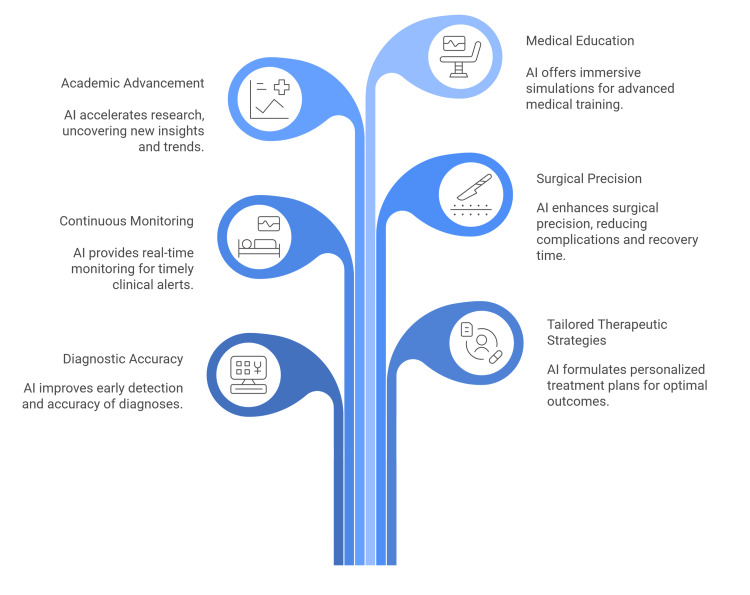 Figure 1
 Figure 2
Peer Reviews
No public reviews on file for this paper yet. If you reviewed it on a platform where reviews are public (OpenReview, ICLR, NeurIPS, ICML), you can paste yours below so the community can read it here.
Videos
No videos yet. Explain this paper in a talk, walkthrough, or lecture? Add one.
Taxonomy
TopicsPediatric Urology and Nephrology Studies · Urological Disorders and Treatments · Congenital gastrointestinal and neural anomalies