Predicting cognitive worsening using subjective reports of dyads and biological biomarkers in pre‐clinical stages: Preliminary results from the CompAS cohort study
Lucía Pérez‐Blanco, Ana I. Rodríguez‐Pérez, Alba Felpete, Ana Nieto‐Vieites, Fátima Fernández‐Feijoo, Cristina Lojo‐Seoane, Onésimo Juncos‐Rabadán, David Facal, Arturo X. Pereiro Rozas

TL;DR
This study explores how memory complaints and blood biomarkers can predict cognitive decline in older adults who are currently cognitively healthy.
Contribution
The study combines subjective memory reports and plasma biomarkers to predict cognitive worsening in preclinical stages of dementia.
Findings
Higher participant-reported memory failure scores were linked to increased risk of cognitive worsening.
Plasma p-tau217 levels were significantly associated with progression to MCI or dementia.
The model showed high specificity but low sensitivity in predicting cognitive decline.
Abstract
The utility of cognitive complaints and biological biomarkers as a factor risk of dementia among cognitively unimpaired individuals is not yet clear (Nosheny et al., 2022). Our aim was to study the joint contribution of subjective reports and some plasma biomarkers to predict cognitive worsening from preclinical stages. One‐hundred older adults identified as CU and SCD from the CompAS study, and their corresponding informants, were followed with an average time of 59.86 months (range=47‐77; SD=7.36). After an extensive neuropsychological assessment, they were diagnosed by applying consensus criteria. The Memory Failure of Everyday (MFE), a 28‐item questionnaire (Sunderland et al., 1984), was administered at baseline to participants and informants for assessing memory complaints and plasma biomarkers p‐tau217, Aβ42 and Aβ40 were obtained from participants (see Table 1). Logistic…
Genes, proteins, chemicals, diseases, species, mutations and cell lines named across the full text — each resolved to its canonical identifier and authoritative record.
Click any figure to enlarge with its caption.
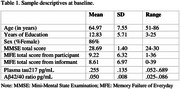 Figure 1
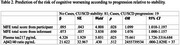 Figure 2
Peer Reviews
No public reviews on file for this paper yet. If you reviewed it on a platform where reviews are public (OpenReview, ICLR, NeurIPS, ICML), you can paste yours below so the community can read it here.
Videos
No videos yet. Explain this paper in a talk, walkthrough, or lecture? Add one.
Taxonomy
TopicsDementia and Cognitive Impairment Research · Traumatic Brain Injury Research · Elder Abuse and Neglect