Tau PET load in early‐ and late‐onset Alzheimer's disease: A cross‐sectional and longitudinal comparison of the LEADS and ADNI cohorts
Konstantinos Chiotis, Ganna Blazhenets, Daniel R. Schonhaut, Julien Lagarde, David N. Soleimani‐Meigooni, Piyush Maiti, Jiaxiuxiu Zhang, Ranjani Shankar, Alinda Amuiri, Salma Rocha, Dustin B. Hammers, Ani Eloyan, Robert A. Koeppe, Maria C. Carrillo, Brad Dickerson

TL;DR
This study compares tau protein buildup in early- and late-onset Alzheimer's disease, finding that early-onset cases have more severe and faster tau accumulation.
Contribution
The study reveals distinct patterns of tau progression in early-onset Alzheimer's compared to late-onset, using longitudinal and cross-sectional data.
Findings
Early-onset Alzheimer's patients show higher baseline tau levels in neocortical regions compared to late-onset patients.
EOAD exhibits faster tau accumulation over time, especially in frontal and occipital brain areas.
Tau accumulation rates are inversely related to age in both early- and late-onset Alzheimer's.
Abstract
We aimed to assess differences in baseline and longitudinal tau PET tracer binding between early‐onset Alzheimer's disease (EOAD) and late‐onset Alzheimer's disease (LOAD) in the LEADS and ADNI cohorts, respectively. We analyzed amyloid‐beta PET‐positive, cognitively impaired participants from the LEADS (EOAD; n = 383) and ADNI (LOAD; n = 196) cohorts with available 18F‐Flortaucipir tau PET data (Table 1). A subset had longitudinal 18F‐Flortaucipir PET data from LEADS (n = 232) and ADNI (n = 94) with average follow‐up intervals of 1.95 and 2.44 years, respectively. All 18F‐Flortaucipir PET scans were processed using the CenTauR pipeline. Cognitively normal participants from LEADS (n = 94) and ADNI (n = 421) with baseline 18F‐Flortaucipir and amyloid‐beta PET scans were also analyzed for comparison. We performed EOAD vs. LOAD comparisons using multivariate linear and linear…
Genes, proteins, chemicals, diseases, species, mutations and cell lines named across the full text — each resolved to its canonical identifier and authoritative record.
Click any figure to enlarge with its caption.
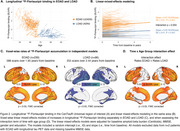 Figure 1
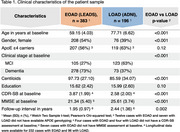 Figure 2
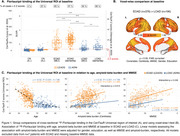 Figure 3
Peer Reviews
No public reviews on file for this paper yet. If you reviewed it on a platform where reviews are public (OpenReview, ICLR, NeurIPS, ICML), you can paste yours below so the community can read it here.
Videos
No videos yet. Explain this paper in a talk, walkthrough, or lecture? Add one.
Taxonomy
TopicsDementia and Cognitive Impairment Research · Alzheimer's disease research and treatments · Medical Imaging Techniques and Applications