Childhood neighborhood socioeconomic position and levels of plasma markers of Alzheimer's disease pathology and neurodegeneration in adulthood; the Atherosclerosis Risk in Communities Study
Anna M. Kucharska‐Newton, Jennifer Chen, James Russell Pike, Hannah Pleasants, Pamela L. Lutsey, Ganga Bey, Erin L. Abner, Eric A Whitsel, James D Stewart, Priya Palta

TL;DR
This study found that growing up in a low-income neighborhood is linked to higher levels of Alzheimer's-related biomarkers in midlife, but not in older age.
Contribution
The study is the first to link childhood socioeconomic position with plasma biomarkers of Alzheimer's pathology and neurodegeneration in midlife and late life.
Findings
Lower childhood socioeconomic position was associated with higher midlife plasma pTau181, NfL, and GFAP concentrations.
Differences in biomarker levels between childhood socioeconomic groups were reduced in late life.
The Aβ42/40 ratio was not associated with childhood socioeconomic position at any age.
Abstract
Early life exposure to adverse experiences correlates with poor health outcomes in adulthood. We therefore examined the association of childhood neighborhood socioeconomic position (nSEP) with midlife and late life levels of plasma‐based biomarkers of Alzheimer's disease (AD) pathology and neurodegeneration. The study population included 1362 Atherosclerosis Risk in Communities (ARIC) cohort participants (mean [SD] midlife age: 58.1 [4.8] years; 60.2% female; 26.4% Black) with amyloid‐β 42/40 (Aβ42/40), pTau‐181, neurofilament light chain (NfL), and glial fibrillary acidic protein (GFAP) ascertained at midlife (Visit 3; 1996‐1982) and older adulthood (Visit 5; 2011‐2013) using Quanterix Simoa assays. We used residential addresses at age 10 years to create a childhood composite of six, z‐scored U.S. Census‐based measures of nSEP: median household income; median value of owner‐occupied…
Genes, proteins, chemicals, diseases, species, mutations and cell lines named across the full text — each resolved to its canonical identifier and authoritative record.
Click any figure to enlarge with its caption.
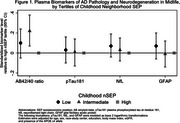 Figure 1
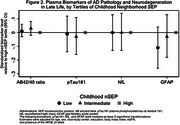 Figure 2
Peer Reviews
No public reviews on file for this paper yet. If you reviewed it on a platform where reviews are public (OpenReview, ICLR, NeurIPS, ICML), you can paste yours below so the community can read it here.
Videos
No videos yet. Explain this paper in a talk, walkthrough, or lecture? Add one.
Taxonomy
TopicsHealth disparities and outcomes · Dementia and Cognitive Impairment Research · Health, Environment, Cognitive Aging