Effectiveness of Self‐Administered Mobile Assessment in Detecting Mild Cognitive Impairment
Huitong Ding, Chenglin Lyu, Edward Searls, Kristi Ho, Zexu Li, Alexa Burk, Margaret Low, Kaitlyn Anderson, Owen Tan, Xavier Serrano, Eric G. Steinberg, Jesse Mez, Katherine A. Gifford, Michael L Alosco, Vijaya B. Kolachalama, Honghuang Lin, Rhoda Au

TL;DR
This study shows that a smartphone-based cognitive test can detect early signs of cognitive decline, potentially offering a convenient tool for monitoring brain health.
Contribution
The study demonstrates that self-administered mobile assessments can effectively detect mild cognitive impairment through digital cognitive measures.
Findings
Digital measures from the code substitution task were strongly associated with MCI, with cognitive efficiency showing a 76% reduction in odds of MCI per standard deviation increase.
Only measures related to executive function were sensitive to MCI detection, while other tasks like go/no-go and spatial processing were not significantly associated.
The study supports the use of smartphone-based tools as a viable alternative for cognitive monitoring and early detection of cognitive impairment.
Abstract
Self‐administered mobile cognitive assessment tools such as the Defense Automated Neurobehavioral Assessment (DANA) have recently emerged as promising solutions for the efficient monitoring of cognitive health. This study investigated the association of DANA with the risk of mild cognitive impairment (MCI). The study sample included participants enrolled in the Boston University Alzheimer's Disease Research Center (BU ADRC) who completed six DANA tasks on their smartphone, yielding five digital cognitive measures per task (four response time metrics and cognitive efficiency). Participants were categorized as either cognitively intact or diagnosed with MCI based on consensus diagnostic meetings at the BU ADRC, adhering to the criteria set by the National Alzheimer's Coordinating Center Uniform Data Set. Digital measures were standardized to have a mean of zero and a standard deviation…
Genes, proteins, chemicals, diseases, species, mutations and cell lines named across the full text — each resolved to its canonical identifier and authoritative record.
Click any figure to enlarge with its caption.
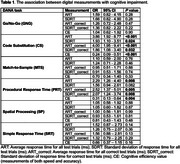 Figure 1
Peer Reviews
No public reviews on file for this paper yet. If you reviewed it on a platform where reviews are public (OpenReview, ICLR, NeurIPS, ICML), you can paste yours below so the community can read it here.
Videos
No videos yet. Explain this paper in a talk, walkthrough, or lecture? Add one.
Taxonomy
TopicsDementia and Cognitive Impairment Research · Traumatic Brain Injury Research · Cancer-related cognitive impairment studies