Systolic Blood Pressure and Type 2 Diabetes Modify the Relationship Between Alzheimer's Disease Biomarkers and Cognitive/Functional Impairment
Tamare V Adrien, Krithika Sivaramakrishnan, Louisina Morancy, Ambar Perez‐Lao, Franchesca Arias, Breton M. Asken, Idaly Velez‐Uribe, Monica Rosselli, Melissa J. Armstrong, Rosie Elena Curiel, David A. Loewenstein, Ranjan Duara, Glenn E. Smith, Shellie‐Anne Levy

TL;DR
This study shows that high blood pressure and diabetes change how Alzheimer's biomarkers relate to cognitive decline, suggesting vascular health plays a key role.
Contribution
The study identifies how vascular risk factors modify the relationship between Alzheimer's biomarkers and impairment in older adults.
Findings
Higher systolic blood pressure strengthens the link between GFAP and cognitive/functional impairment.
Type 2 Diabetes increases the effect of GFAP on impairment but weakens the effect of NFL.
PTau217's association with impairment weakens as systolic blood pressure increases.
Abstract
Vascular risk factors contribute to Alzheimer's disease (AD) dementia, but their interaction with AD pathology remains unclear. This study examined systolic blood pressure (SYSBP) and Type 2 Diabetes (T2D) as moderators of the relationship between plasma biomarkers and cognitive and functional impairment in older adults. Data from 479 participants (Table 1.) in the 1Florida Alzheimer's Disease Research Center were analyzed. SYSBP and T2D were assessed, and plasma biomarkers included GFAP, NFL, Ptau181, and Ptau217. Linear regressions and post‐hoc simple slopes analyses examined whether SYSBP and T2D moderated biomarker associations with impairment, measured by the Clinical Dementia Rating Scale‐Sum of Boxes, controlling for age, sex, education, and APOE status. See table 2. In brief, a significant positive interaction was found between GFAP and SYSBP on impairment (b = 0.074, p =…
Genes, proteins, chemicals, diseases, species, mutations and cell lines named across the full text — each resolved to its canonical identifier and authoritative record.
Click any figure to enlarge with its caption.
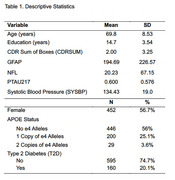 Figure 1
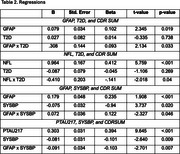 Figure 2
Peer Reviews
No public reviews on file for this paper yet. If you reviewed it on a platform where reviews are public (OpenReview, ICLR, NeurIPS, ICML), you can paste yours below so the community can read it here.
Videos
No videos yet. Explain this paper in a talk, walkthrough, or lecture? Add one.
Taxonomy
TopicsDementia and Cognitive Impairment Research · Alzheimer's disease research and treatments · Neurological Disease Mechanisms and Treatments