A protein panel including pTau217 outperforms pTau217 alone in identifying high tau load in amyloid positive individuals
Guglielmo Di Molfetta, Wagner Scheeren Brum, Andrea Benedet, Nesrine Rahmouni, Jenna Stevenson, Ilaria Pola, Laia Montoliu‐Gaya, Kaj Blennow, Henrik Zetterberg, Pedro Rosa‐Neto, Nicholas J. Ashton

TL;DR
A blood test combining pTau217 with other proteins better identifies advanced tau pathology in Alzheimer's patients than pTau217 alone.
Contribution
A multi-protein blood panel including pTau217 improves detection of high tau load in amyloid-positive individuals compared to pTau217 alone.
Findings
A multi-analyte panel (AUC=0.93) outperformed pTau217 alone (AUC=0.88) in predicting BraakLate stages.
NPTXR, GDNF, and VGF were identified as complementary proteins to pTau217.
The multi-analyte model had a better fit and lower AIC score than pTau217 alone.
Abstract
Recent anti‐amyloid trial designs for Alzheimer's disease (AD) have aimed to identify amyloid‐β (Aβ)‐positive patients without an advanced tau pathology, as they are most likely to benefit from these therapies. Blood‐based biomarkers might reduce the need to use cerebrospinal fluid (CSF) or positron emission tomography (PET) but it is unclear whether phosphorylated tau‐217 (pTau217) alone would be effective to exclude this high‐tau group at screening. We investigated whether a blood‐based protein panel, including pTau217, could better distinguish early from late‐stage tau pathology in Aβ‐positive patients compared to pTau217 alone. Aβ‐positive participants from the TRIAD cohort (n = 129; mean [SD] age, 70.4 [8.3] years; females [58.9%]) were classified as BraakLate (Braak V‐VI: n = 51) or BraakEarly (Braak I‐IV: n = 78) by tau PET imaging([18F]MK6240). We employed the NULISAseq CNS…
Genes, proteins, chemicals, diseases, species, mutations and cell lines named across the full text — each resolved to its canonical identifier and authoritative record.
Click any figure to enlarge with its caption.
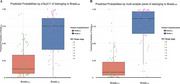 Figure 1
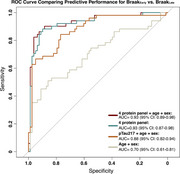 Figure 2
Peer Reviews
No public reviews on file for this paper yet. If you reviewed it on a platform where reviews are public (OpenReview, ICLR, NeurIPS, ICML), you can paste yours below so the community can read it here.
Videos
No videos yet. Explain this paper in a talk, walkthrough, or lecture? Add one.
Taxonomy
TopicsAlzheimer's disease research and treatments · Dementia and Cognitive Impairment Research · Advanced Proteomics Techniques and Applications