Interplay between Alzheimer and vascular pathology as determinants of plasma neurofilament light in a memory clinic population
Michelle C. Barboure, Inge M.W. Verberk, Sinthujah Vigneswaran, Frederik Barkhof, Elsmarieke van de Giessen, Geert Jan Biessels, Charlotte E. Teunissen, Wiesje M. van der Flier, Argonde C. van Harten

TL;DR
This study explores how Alzheimer's and vascular brain changes together affect a blood marker for brain damage, showing that vascular issues have a bigger impact in people without Alzheimer's signs.
Contribution
The study reveals that vascular pathology significantly influences plasma NfL levels, especially in amyloid-negative individuals, highlighting the need to consider combined pathologies in clinical interpretation.
Findings
NfL levels increased stepwise with combined amyloid and vascular pathology, suggesting an additive effect.
Vascular burden (SVD score) was a stronger predictor of NfL levels in amyloid-negative individuals.
Dementia diagnosis emerged as a strong determinant of NfL levels, particularly in amyloid-negative cases.
Abstract
Plasma neurofilament light (NfL) is increasingly used as a general marker for neurodegeneration in memory clinics to aid differential diagnosis. However, interpreting its levels in the presence of vascular pathology remains unclear. We investigated the individual and combined effects of Alzheimer's and vascular pathologies on plasma NfL in individuals across the cognitive spectrum. Cross‐sectional data from 1099 individuals in the Amsterdam Dementia Cohort were analyzed, including participants with a clinical diagnosis of subjective cognitive decline (SCD, n = 371), mild cognitive impairment (MCI, n = 326), Alzheimer's disease (AD, n = 347), and vascular dementia (VaD, n = 55). NfL was measured using SIMOA (Quanterix) and log‐transformed. Amyloid pathology was defined by positive CSF/PET biomarkers. Vascular pathology was defined as having a small vessel disease (SVD) score ≥1 (range…
Genes, proteins, chemicals, diseases, species, mutations and cell lines named across the full text — each resolved to its canonical identifier and authoritative record.
Click any figure to enlarge with its caption.
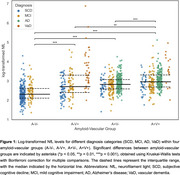 Figure 1
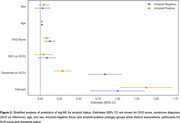 Figure 2
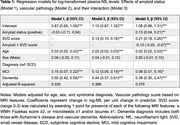 Figure 3
Peer Reviews
No public reviews on file for this paper yet. If you reviewed it on a platform where reviews are public (OpenReview, ICLR, NeurIPS, ICML), you can paste yours below so the community can read it here.
Videos
No videos yet. Explain this paper in a talk, walkthrough, or lecture? Add one.
Taxonomy
TopicsDementia and Cognitive Impairment Research · Alzheimer's disease research and treatments · Skin and Cellular Biology Research