Association Between Metabolic Syndrome, Obesity, and Cognitive Performances in Individuals With Bipolar Disorders: Cross‐Sectional and Longitudinal Analyses in the FACE‐BD Cohort
I. Palimaru, B. Etain, M. Leboyer, Y. Dansou, P. Favre, S. Gard, V. Aubin, F. Bellivier, R. Belzeaux, P. Courtet, C. Dubertret, E. Haffen, A. Lefrere, P. M. Llorca, E. Olié, M. Polosan, L. Samalin, R. Schwan, B. Etain, B. Etain, E. Olié, M. Leboyer, E. Haffen, P. M. Llorca

TL;DR
This study finds that metabolic syndrome is linked to worse cognitive performance in people with bipolar disorder, but not to cognitive decline over time.
Contribution
The study provides new cross-sectional and longitudinal evidence on the cognitive impact of metabolic syndrome in bipolar disorder.
Findings
Metabolic syndrome is associated with poorer cognitive performance in individuals with bipolar disorder.
Longitudinal analysis found no significant cognitive decline linked to metabolic syndrome over two years.
Cognitive flexibility, inhibition, and verbal memory were specifically affected by metabolic syndrome.
Abstract
Metabolic syndrome (MetS) has been suggested to be associated with cognitive impairments in bipolar disorder (BD); however, studies are limited by small sample sizes or cross‐sectional design. Our objective is to evaluate the cross‐sectional and longitudinal associations between MetS and cognitive performances in a large cohort of individuals with BD. 1175 individuals with a DSM‐IV diagnosis of BD were included from the FACE‐BD cohort, assessed with a standardized battery of clinical and neuropsychological tests and followed up with a cognitive retest at 2 years for a subsample (n = 367). A global cognitive index was created by using a Principal Component Analysis. Associations between MetS and cognitive performances at baseline were explored using multiple analyses of covariance and linear mixed models were used for longitudinal data. The prevalence of MetS was 21.5% in this sample.…
Genes, proteins, chemicals, diseases, species, mutations and cell lines named across the full text — each resolved to its canonical identifier and authoritative record.
Click any figure to enlarge with its caption.
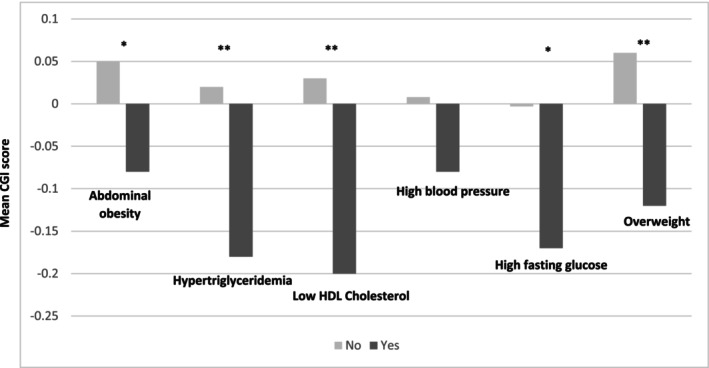 Figure 1
Peer Reviews
No public reviews on file for this paper yet. If you reviewed it on a platform where reviews are public (OpenReview, ICLR, NeurIPS, ICML), you can paste yours below so the community can read it here.
Videos
No videos yet. Explain this paper in a talk, walkthrough, or lecture? Add one.
Taxonomy
TopicsBipolar Disorder and Treatment · Schizophrenia research and treatment · Phosphodiesterase function and regulation