Psychometric Properties of the Traditional Chinese Version of the Interprofessional Collaborative Competency Attainment Survey
Yawen Lee, Chihlung Chiang, Yungsung Wen, Chinyi Huang, Hsintzu Li, Chihhao Lin

TL;DR
This study created a culturally adapted survey to assess interprofessional healthcare competencies in Taiwan, ensuring it is reliable and valid for use in hierarchical healthcare systems.
Contribution
The study introduces a culturally sensitive Traditional Chinese version of an interprofessional competency survey validated for use in Taiwan's healthcare context.
Findings
The TC-ICCAS demonstrated a six-domain structure with confirmed construct validity.
All subscales showed high internal consistency (Cronbach's α = 0.86–0.93).
The limited discriminant validity of one domain was interpreted as a reflection of cultural sensitivity rather than a flaw.
Abstract
This study aimed to develop and validate the Traditional Chinese version of the Interprofessional Collaborative Competency Attainment Survey (TC‐ICCAS), a culturally sensitive tool for assessing interprofessional education (IPE) competencies in Taiwan's hierarchical healthcare system. Conducted from 2022 to 2023 at a tertiary medical center and guided by the COSMIN framework, this psychometric validation study involved 324 early‐career healthcare professionals. A three‐phase process was employed: (1) translation and cultural adaptation with expert review; (2) pilot testing with 30 professionals to ensure cultural relevance; and (3) field testing using post‐IPE program surveys. Confirmatory factor analysis (CFA) of the field test data confirmed the instrument's six‐domain structure (communication, collaboration, roles and responsibilities, patient‐centered care, conflict management, and…
Genes, proteins, chemicals, diseases, species, mutations and cell lines named across the full text — each resolved to its canonical identifier and authoritative record.
Click any figure to enlarge with its caption.
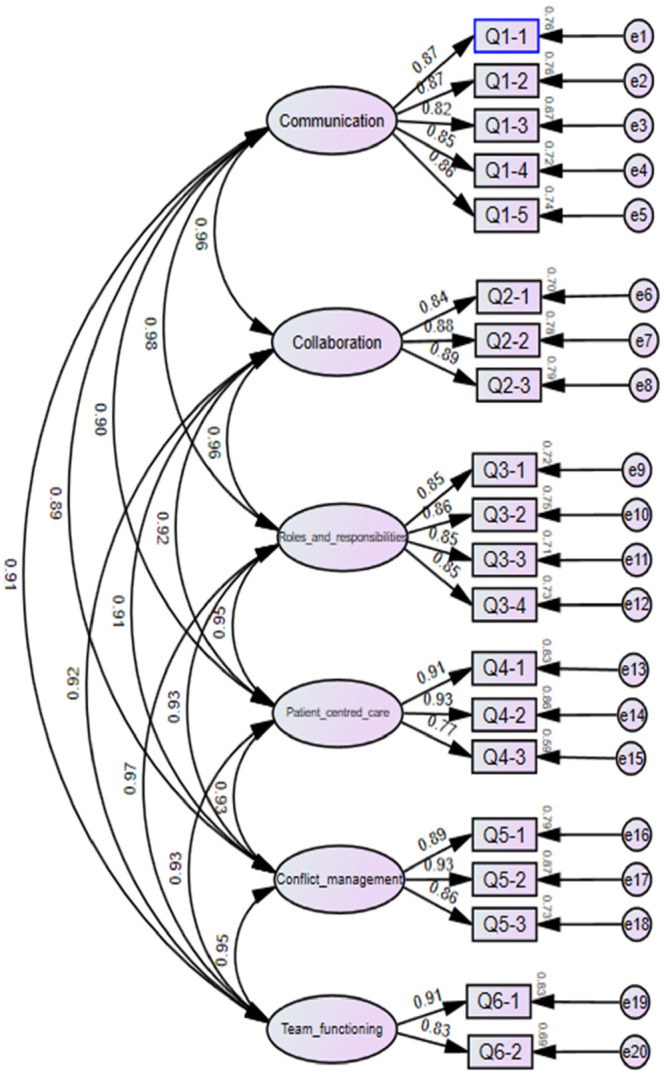 Figure 1
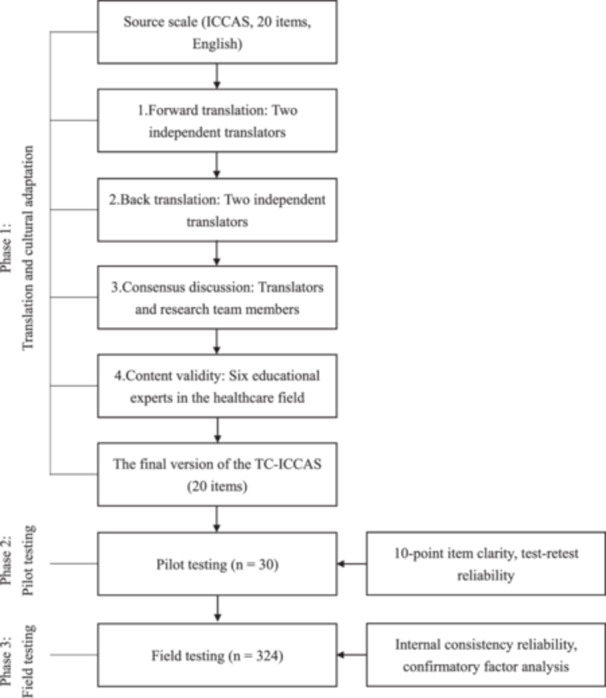 Figure 2
Peer Reviews
No public reviews on file for this paper yet. If you reviewed it on a platform where reviews are public (OpenReview, ICLR, NeurIPS, ICML), you can paste yours below so the community can read it here.
Videos
No videos yet. Explain this paper in a talk, walkthrough, or lecture? Add one.
Taxonomy
TopicsInterprofessional Education and Collaboration · Interdisciplinary Research and Collaboration · Innovations in Medical Education