Metal‐Coordination Specificity and Structural Dynamics of C. elegans Metallothionein I: Insights From 3D Modeling and MD Simulations
Nilvea Ramalho de Oliveira, Andrei Santos Siqueira, Paulo Sérgio Alves Bueno, Evonnildo Costa Gonçalves, Juliano Zanette

TL;DR
This study explores how a protein from C. elegans interacts with different metal ions, revealing how metal binding affects its structure and stability.
Contribution
The study provides new insights into the structural dynamics and metal coordination specificity of C. elegans metallothionein I using 3D modeling and MD simulations.
Findings
The metal-free form of MTL-1 is highly flexible and disordered, with most of its structure composed of coils, bends, and turns.
Metal binding, especially with Zn2+, Cd2+, Cu2+, and Hg2+, increases structural stability and reduces flexibility.
Pb2+ binding results in a less stable and more dynamic structure compared to other metal ions.
Abstract
Metallothioneins (MTLs) are small, cysteine‐rich proteins known for their ability to bind metal ions and exhibit flexible, disordered structures. The structural and functional characteristics of metallothionein I (MTL‐1) from Caenorhabditis elegans were investigated, focusing on its behavior in both metal free (MTL‐1 Apo) and metal‐bond states with Zn2+, Cd2+, Cu2+, Hg2+, and Pb2+ divalent metal ions. Using molecular dynamics simulations and 3D modeling via AlphaFold, we characterized the flexibility and stability of MTL. The MTL‐1 Apo form displayed high flexibility, aligning with its intrinsically disordered protein (IDP) nature, with 89.3% of its structure composed of coils, bends, and turns. Metal binding significantly enhanced the protein's stability, particularly with Zn2+, Cd2+, Cu2+, and Hg2+, reducing root mean square deviation (RMSD), root mean square fluctuation (RMSF),…
Genes, proteins, chemicals, diseases, species, mutations and cell lines named across the full text — each resolved to its canonical identifier and authoritative record.
Click any figure to enlarge with its caption.
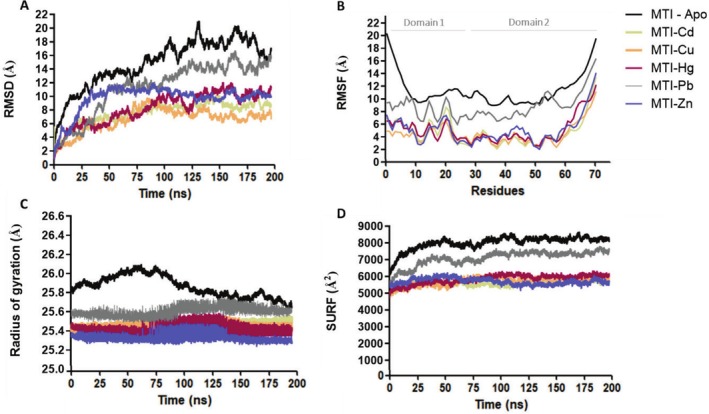 Figure 1
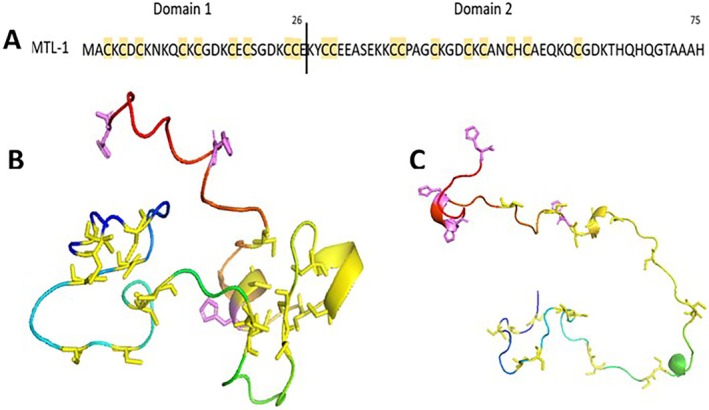 Figure 2
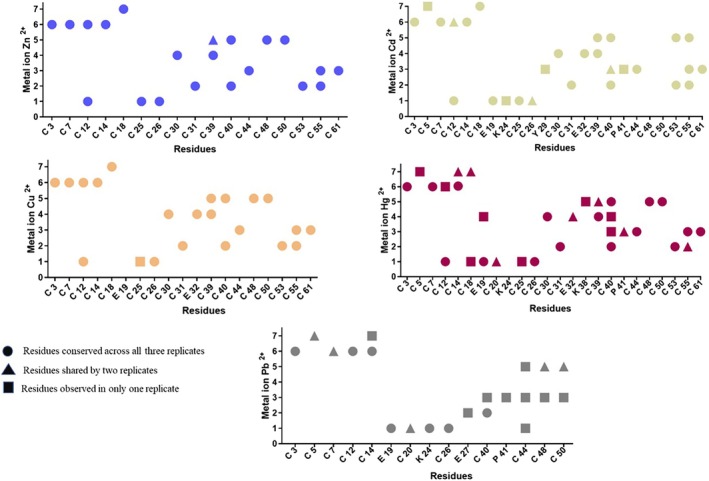 Figure 3
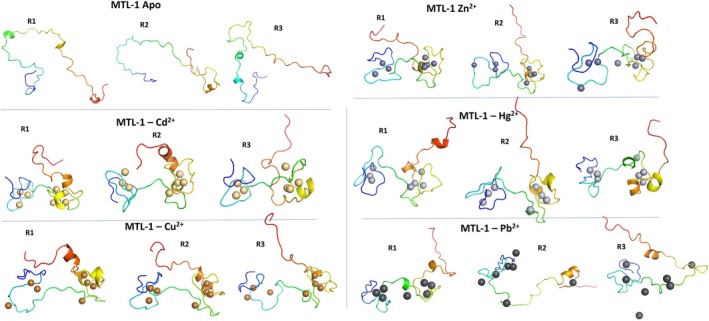 Figure 4
Peer Reviews
No public reviews on file for this paper yet. If you reviewed it on a platform where reviews are public (OpenReview, ICLR, NeurIPS, ICML), you can paste yours below so the community can read it here.
Videos
No videos yet. Explain this paper in a talk, walkthrough, or lecture? Add one.
Taxonomy
TopicsTrace Elements in Health · Enzyme Structure and Function · Plant Micronutrient Interactions and Effects