Efficacy and Efficiency of In‐House Clear Aligners in Limited Orthodontic Treatment
Michael C. Kessler, Joon Han, George J. Eckert, Lana Helms, Jay A. Hughes, Phillip Wong, Carolina Frota, Vinicius Dutra, Hakan Turkkahraman, R. Scott Conley

TL;DR
This study evaluates how well in-house clear aligners work for limited orthodontic treatments by analyzing tooth movement accuracy in patients.
Contribution
The study introduces a new method for assessing the accuracy of in-house clear aligner treatments using digital scans and statistical analysis.
Findings
91% of mandibular and 95% of maxillary landmarks showed clinically acceptable tooth movement.
Mandibular canines were more predictable than incisors in movement accuracy.
Maxillary torque movements had the lowest accuracy among all tooth movements.
Abstract
To evaluate the efficacy and efficiency of in‐house digital software and fabrication of clear aligners. This retrospective study analysed pre‐treatment, predicted and post‐treatment digital scans of 61 patients (42 females, 19 males) to assess the accuracy of predicted tooth movements. Planned and final scans were superimposed using best‐fit analysis in Geomagic Design X (Hexagon AB, Stockholm, Sweden). Distoincisal (DI), mesioincisal (MI) and gingival zenith (Z) landmarks were measured perpendicularly from the mid‐facial aspect, with differences < 0.5 mm deemed clinically acceptable. Data were analysed using repeated‐measures ANOVA with logarithmic transformation, and clinically acceptable movements were compared between groups using generalised estimating equations (GEE). When evaluated individually, 91% of mandibular and 95% of maxillary landmarks showed clinically acceptable…
Genes, proteins, chemicals, diseases, species, mutations and cell lines named across the full text — each resolved to its canonical identifier and authoritative record.
Click any figure to enlarge with its caption.
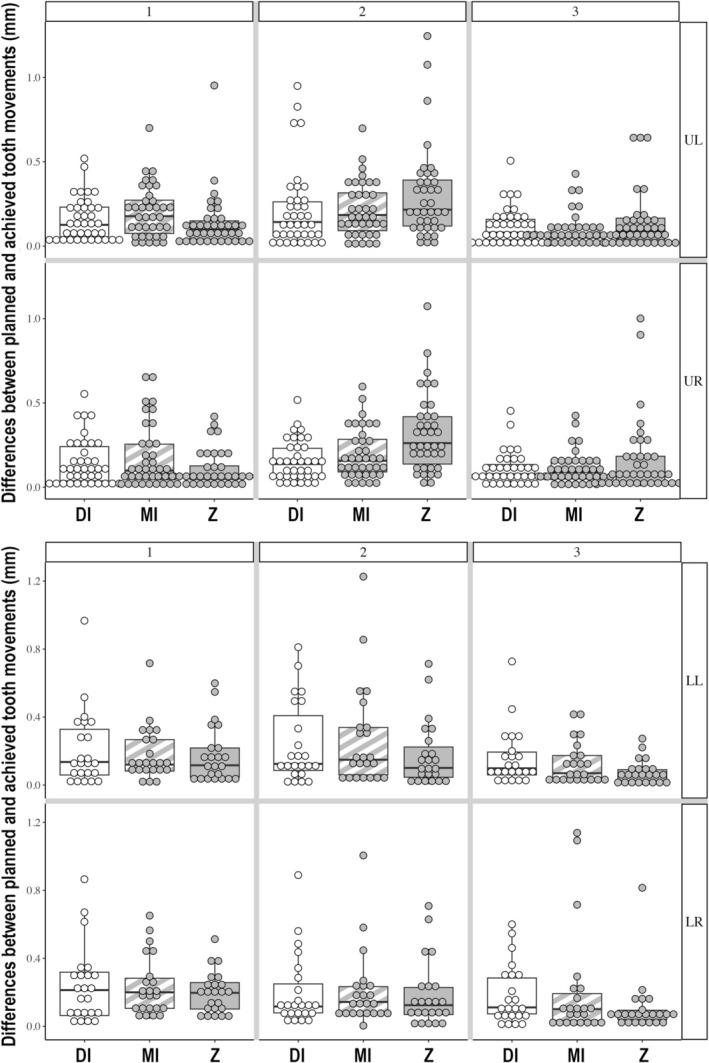 Figure 1
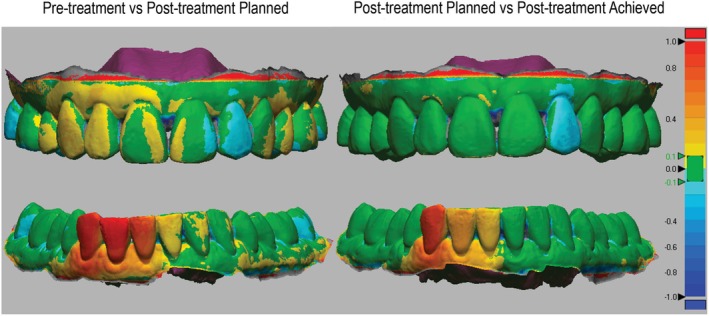 Figure 2
Peer Reviews
No public reviews on file for this paper yet. If you reviewed it on a platform where reviews are public (OpenReview, ICLR, NeurIPS, ICML), you can paste yours below so the community can read it here.
Videos
No videos yet. Explain this paper in a talk, walkthrough, or lecture? Add one.
Taxonomy
TopicsOrthodontics and Dentofacial Orthopedics · dental development and anomalies · Dental materials and restorations