An emerging clock mechanism in a hydrozoan jellyfish
Ezio Rosato

TL;DR
A new study shows that a jellyfish species uses an internal clock, not just light, to control when it releases eggs.
Contribution
The study identifies a novel endogenous clock mechanism for gamete release in a new hydrozoan jellyfish species.
Findings
Egg release in the jellyfish is governed by an internal clock.
The mechanism operates independently of external light cues.
This finding expands understanding of reproductive timing in marine organisms.
Abstract
The timed release of gametes is an important feature of marine organisms, and in hydrozoan jellyfish is usually controlled by light. A recent study in PLOS Biology reveals an emerging endogenous clock controlling rhythmic egg release in a novel hydrozoan species. In hydrozoan jellyfish, the timing of gamete release is often coordinated by light. This primer discusses findings from a recent PLOS Biology article that elucidates a novel, endogenous clock-based mechanism that governs egg release in a new species of jellyfish.
Genes, proteins, chemicals, diseases, species, mutations and cell lines named across the full text — each resolved to its canonical identifier and authoritative record.
Click any figure to enlarge with its caption.
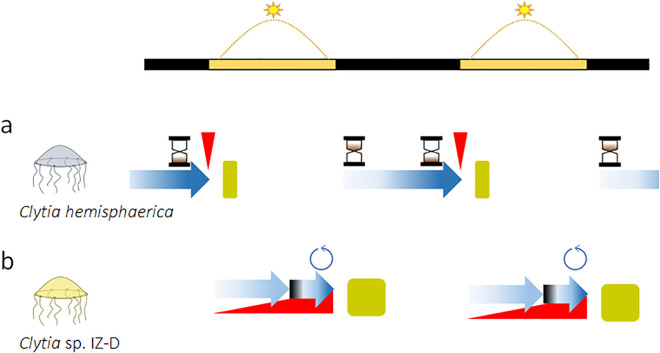 Figure 1
Peer Reviews
No public reviews on file for this paper yet. If you reviewed it on a platform where reviews are public (OpenReview, ICLR, NeurIPS, ICML), you can paste yours below so the community can read it here.
Videos
No videos yet. Explain this paper in a talk, walkthrough, or lecture? Add one.
Taxonomy
TopicsMarine Invertebrate Physiology and Ecology · Developmental Biology and Gene Regulation · Marine Ecology and Invasive Species