Inequality aversion and prosocial punishment: Evidence from a one-shot public goods game
Per F. Andersson, Martina Testori, Sergio Lo Iacono

TL;DR
This study explores why people punish free riders in public goods games and finds that inequality aversion may not be the main driver of such behavior.
Contribution
The study provides new experimental evidence on the relationship between inequality aversion and prosocial punishment in public goods games.
Findings
Inequality aversion does not predict prosocial punishment.
Punishment levels do not significantly differ across treatments.
Redistribution reduces punishment intensity toward richer individuals under high inequality.
Abstract
The willingness to engage in costly punishment of free riders (prosocial punishment) is crucial to foster group cooperation and understand public goods provision. While prosocial punishment is common across societies, its motivations remain unclear. Scholars have suggested that people resist inequitable outcomes and willingly bear costs to sanction free riders, seeking a fairer distribution of payoffs. This study tests a key implication of such fairness-driven arguments: if inequality aversion drives prosocial punishment, individuals should punish less when redistribution occurs, as equality concerns would be already satisfied. We conducted a pre-registered 2x2 between-subjects lab experiment (N=320), where participants completed a Social Value Orientation (SVO) task and played a one-shot Public Goods Game (PGG) with a Punishment Stage. We manipulated endowment inequality and the…
Genes, proteins, chemicals, diseases, species, mutations and cell lines named across the full text — each resolved to its canonical identifier and authoritative record.
Click any figure to enlarge with its caption.
 Figure 1
 Figure 2
 Figure 3
 Figure 4
 Figure 5
 Figure 6
 Figure 7
 Figure 8
 Figure 9
 Figure 10
 Figure 11
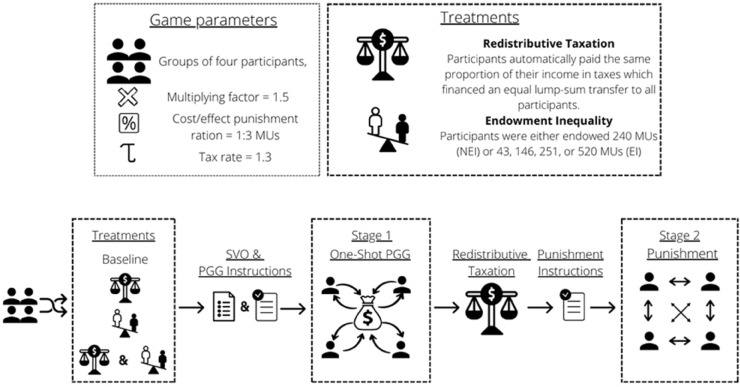 Figure 12
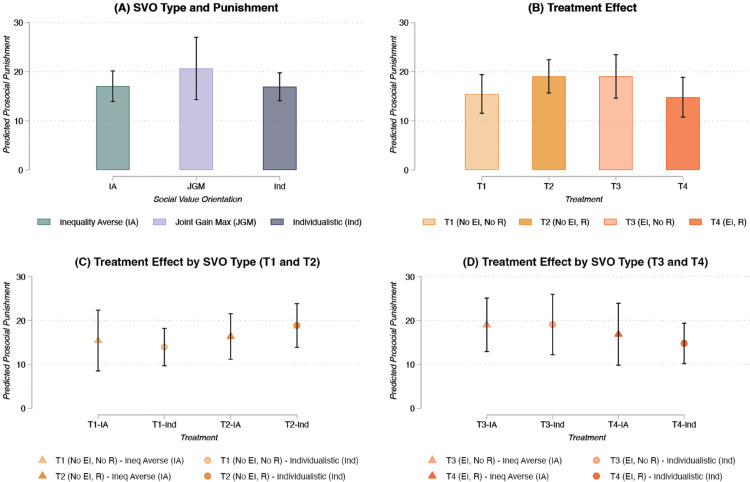 Figure 13
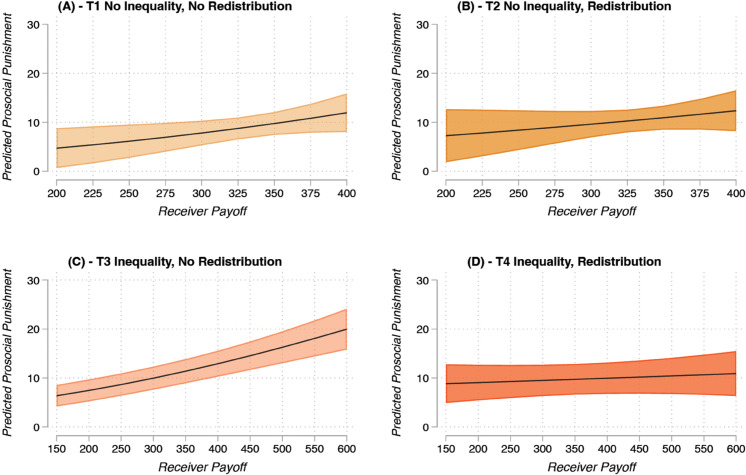 Figure 14
 Figure 15
Peer Reviews
No public reviews on file for this paper yet. If you reviewed it on a platform where reviews are public (OpenReview, ICLR, NeurIPS, ICML), you can paste yours below so the community can read it here.
Videos
No videos yet. Explain this paper in a talk, walkthrough, or lecture? Add one.
Taxonomy
TopicsEvolutionary Game Theory and Cooperation · Experimental Behavioral Economics Studies · Psychology of Moral and Emotional Judgment