Aβ positive, tau biomarker negative cognitive impairment is associated with significant non‐Alzheimer's disease neuropathologies
Konstantinos Ioannou, Richard J. Perrin, Khadidzha Abdullaieva, Marina Bluma, Konstantinos Poulakis, Antoine Leuzy, Dorota Religa, Elena Rodriguez‐Vieitez, Konstantinos Chiotis

TL;DR
This study finds that cognitive impairment linked to Aβ positivity but low tau is often due to non-Alzheimer's disease pathologies, suggesting current biomarker criteria may be incomplete.
Contribution
The study reveals that Aβ-positive, tau-negative cognitive impairment is associated with mixed non-AD neuropathologies, challenging current diagnostic frameworks.
Findings
A+T- individuals show higher rates of mixed AD neuropathology compared to A+T+ individuals.
A+T- cases deviate from expected Alzheimer's disease progression as per recent diagnostic criteria.
Cognitive impairment in A+T- groups is linked to non-AD proteinopathies and vascular brain injury.
Abstract
This study leverages biomarker and autopsy data with the aim to evaluate the impact of mixed pathologies on interpreting cognitive impairment within the Αβ and tau (AT) biomarker system. Individuals with at least one instance of antemortem CSF AD biomarkers measurement (Roche, Elecsys ®) and a full postmortem assessment were identified from the Alzheimer's Disease Neuroimaging Initiative (ADNI) database. Previously validated cut‐offs were used to define A+ (Aβ42 ≤ 981 pg/mL) and T+ (p‐tau181 ≥ 24.3 pg/mL). Aβ PET burden was quantified in‐house using the Centiloid pipeline. AT groups were compared with respect to cognitive performance, CSF α‐synuclein positivity (Amprion, SYNTap ®), Aβ PET burden, clinical comorbidities, and neuropathological evidence of proteinopathies associated with cognitive impairment or vascular brain injury (VBI). Mixed AD was defined as the copresence of…
Genes, proteins, chemicals, diseases, species, mutations and cell lines named across the full text — each resolved to its canonical identifier and authoritative record.
Click any figure to enlarge with its caption.
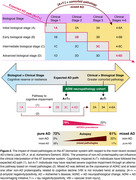 Figure 1
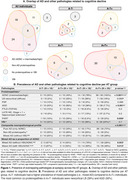 Figure 2
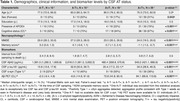 Figure 3
Peer Reviews
No public reviews on file for this paper yet. If you reviewed it on a platform where reviews are public (OpenReview, ICLR, NeurIPS, ICML), you can paste yours below so the community can read it here.
Videos
No videos yet. Explain this paper in a talk, walkthrough, or lecture? Add one.
Taxonomy
TopicsDementia and Cognitive Impairment Research · Alzheimer's disease research and treatments · Intracerebral and Subarachnoid Hemorrhage Research