Evaluating the Biochemical and Haematological Safety of the Histoplasma capsulatum var. farciminosum ‘8ZH’ Vaccine in Foals
Sabira E. Alpysbayeva, Akbope A. Abdykalyk, Kali Tileukhanov, Azamat R. Abdimukhtar, Alinur T. Toleukhan, Makhpal K. Sarmykova, Aktoty M. Anarbekova, Yeraly A. Shayakhmetov, Nazym S. Syrym, Sergazy Sh. Nurabaev, Bolat A. Yespembetov

TL;DR
This study shows that a new vaccine for a fungal disease in horses is safe for young foals, with no serious side effects.
Contribution
The study provides first-time safety validation of the inactivated HCF ‘8ZH’ vaccine in foals.
Findings
No severe adverse reactions were observed in vaccinated foals.
Mild, transient injection-site swelling occurred in three foals but resolved spontaneously.
Biochemical and haematological parameters remained within normal limits, indicating vaccine safety.
Abstract
Epizootic lymphangitis (EEL), caused by Histoplasma capsulatum var. farciminosum (HCF), is a neglected equine fungal disease lacking effective vaccines. The newly developed inactivated ‘8ZH’ vaccine requires safety validation in the target species. To evaluate the biochemical, haematological and clinical safety of the inactivated HCF ‘8ZH’ vaccine in foals. A controlled, single‐blinded study was conducted on 30 clinically healthy foals (4–6 months), randomized into vaccinated (n = 15) and control (n = 15) groups. Vaccinated animals received a 5 mL intramuscular dose (10 mg antigen, MONTANIDE GEL 01 PR adjuvant) on Day 0 and a booster on Day 21. Clinical observations (temperature, appetite, behaviour, injection site) were recorded daily. Blood was collected at baseline and on Days 7, 14, 21, 35 and 42 for biochemical, haematological and acute‐phase protein analysis. Data were analysed…
Genes, proteins, chemicals, diseases, species, mutations and cell lines named across the full text — each resolved to its canonical identifier and authoritative record.
Click any figure to enlarge with its caption.
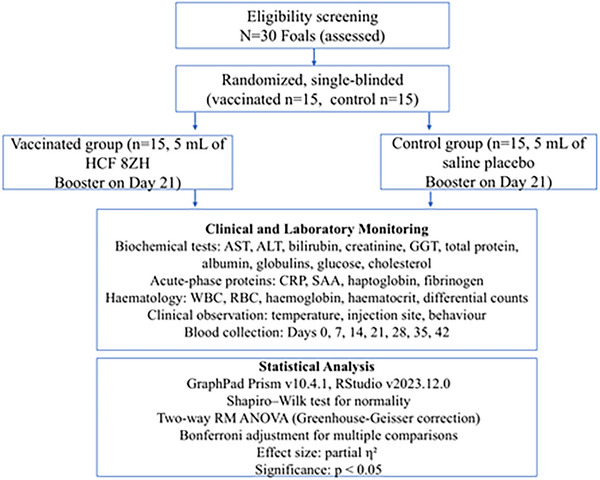 Figure 1
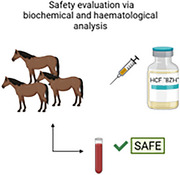 Figure 2
Peer Reviews
No public reviews on file for this paper yet. If you reviewed it on a platform where reviews are public (OpenReview, ICLR, NeurIPS, ICML), you can paste yours below so the community can read it here.
Videos
No videos yet. Explain this paper in a talk, walkthrough, or lecture? Add one.
Taxonomy
TopicsFungal Infections and Studies · Bartonella species infections research · Antifungal resistance and susceptibility