Regional tau quantification methodologies in early symptomatic participants with presence of tau pathology
Diana O Svaldi, Leonardo Iaccarino, Ixavier A. Higgins, Vikas Kotari, Nicolai Franzmeier, Michael Ewers, Sergey Shcherbinin

TL;DR
This study compares different methods for identifying brain regions affected by tau in Alzheimer's disease to improve tracking of disease progression.
Contribution
The study introduces individualized data-driven methods for defining tau target regions that improve signal consistency in longitudinal PET analyses.
Findings
Individual-level data-driven methods showed similar or higher signal-to-noise ratio compared to traditional anatomical composites.
Minimum positive composites provided superior signal-to-noise ratio across methodologies.
Data-driven individualized methods increased spatial homogeneity between participants and across trials.
Abstract
This study compares approaches for defining target regions in their ability to consistently capture tau progression relative to anatomical composites used in Alzheimer's disease trials. Paired, baseline and 18‐month regional flortaucipir data were included from TRAILBLAZER‐ALZ2 (NCT04437511, Low/Medium/High Tau) and TRAILBLAZER‐ALZ (NCT03367403, Low/Medium Tau) placebo participants. Regional SUVRs were combined into four composite regions according to individual‐ versus group‐level and anatomical‐ versus data‐driven approaches. Composites were defined and ranked according to hypothetical longitudinal spatial gradients based on descending mean regional SUVR (Q1→Q4). Anatomical composites were defined by lobes, whereas data‐driven composites (quartiles) were defined by either baseline SUVR or functional connectivity (FC) to the highest baseline SUVR quartile. Group‐level methodologies…
Genes, proteins, chemicals, diseases, species, mutations and cell lines named across the full text — each resolved to its canonical identifier and authoritative record.
Click any figure to enlarge with its caption.
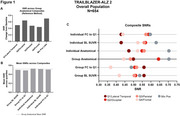 Figure 1
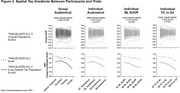 Figure 2
Peer Reviews
No public reviews on file for this paper yet. If you reviewed it on a platform where reviews are public (OpenReview, ICLR, NeurIPS, ICML), you can paste yours below so the community can read it here.
Videos
No videos yet. Explain this paper in a talk, walkthrough, or lecture? Add one.
Taxonomy
TopicsAlzheimer's disease research and treatments · Functional Brain Connectivity Studies · Dementia and Cognitive Impairment Research