Proposal of two novel species, Allocoprococcus similis gen. nov., sp. nov. and Faecalimonas hominis sp. nov., isolated from human faeces and genome-based reorganization of the genus Coprococcus
Eri Yamamoto, Atsushi Hisatomi, Kana Miwa, Naomi Sakurai, Akiko Koizumi, Moriya Ohkuma, Hanae Tsuchihashi, Mitsuo Sakamoto

TL;DR
Two new bacterial species and a genome-based reorganization of the genus Coprococcus are proposed based on strains isolated from human feces.
Contribution
The paper introduces two novel bacterial species and reclassifies several species within the genus Coprococcus using genomic data.
Findings
Strains OB7620T and OB7656T represent two new species, Allocoprococcus similis and Faecalimonas hominis.
Genomic analysis led to the reclassification of Coprococcus comes into a new genus, Allocoprococcus.
Coprococcus immobilis and Coprococcus catus are reclassified into the new genus Pseudocoprococcus.
Abstract
The obligately anaerobic, Gram-stain-positive coccobacilli strains OB7620T and OB7656T were isolated from faecal samples of healthy Japanese volunteers. Strain OB7620T showed the highest 16S rRNA gene sequence similarity to Coprococcus comes ATCC 27758T (98.4%) and Clostridium nexile DSM 1787T (96.3%). Strain OB7656T showed the highest 16S rRNA gene sequence similarity to ‘Gluceribacter canis’ NATH-2371T (97.7%), C. nexile DSM 1787T (94.8%) and Faecalimonas umbilicata EGH7T (94.8%). These findings indicate that the two strains represent novel species. Genomic analysis clarified the phylogenetic relationship of C. comes with the species cluster designated as Coprococcus sensu stricto, which includes the type species, C. eutactus. As C. comes is distinct from the species of Coprococcus sensu stricto, C. comes is reclassified into a novel genus, Allocoprococcus, as Allocoprococcus comes…
Genes, proteins, chemicals, diseases, species, mutations and cell lines named across the full text — each resolved to its canonical identifier and authoritative record.
Click any figure to enlarge with its caption.
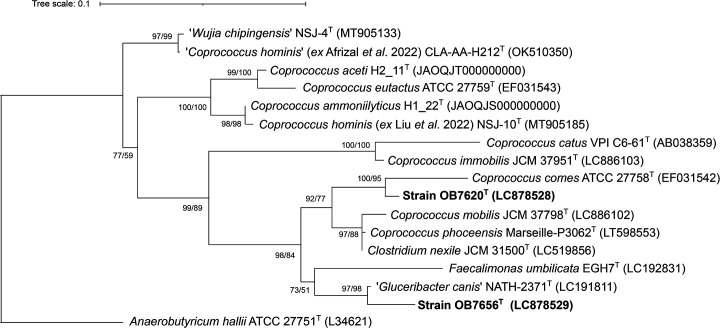 Figure 1
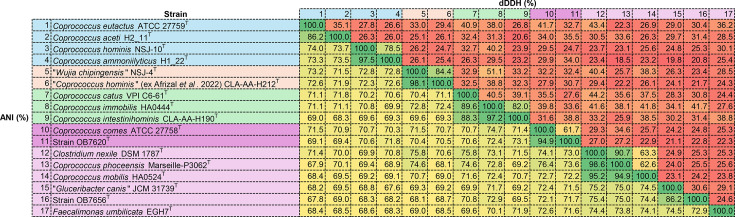 Figure 2
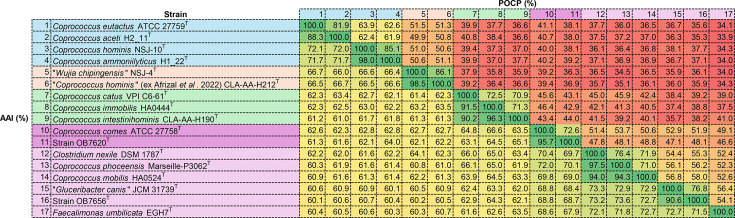 Figure 3
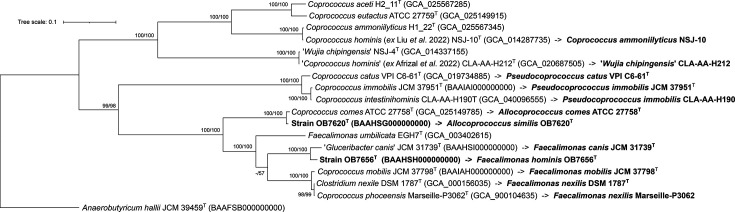 Figure 4
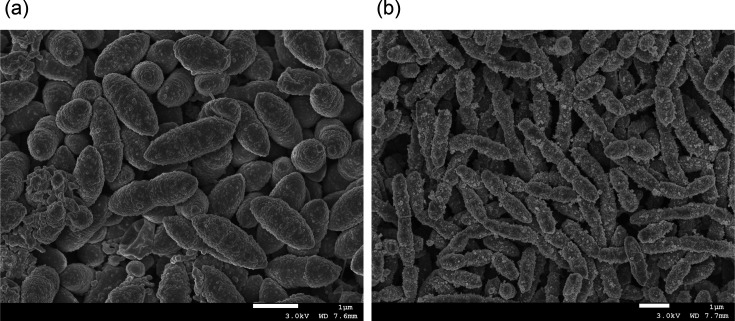 Figure 5
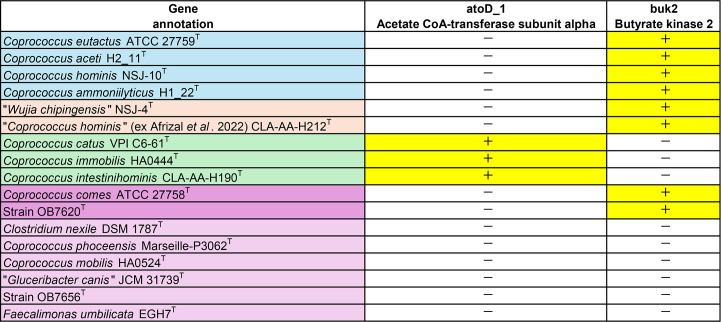 Figure 6
Peer Reviews
No public reviews on file for this paper yet. If you reviewed it on a platform where reviews are public (OpenReview, ICLR, NeurIPS, ICML), you can paste yours below so the community can read it here.
Videos
No videos yet. Explain this paper in a talk, walkthrough, or lecture? Add one.
Taxonomy
TopicsGenomics and Phylogenetic Studies · Probiotics and Fermented Foods · Gut microbiota and health