Disease timeline modelling of amyloid and tau PET reveals dynamic timescales of amyloid and tau accumulation in Alzheimer's disease
Alexandra L Young, Peter A Wijeratne, Leon M. Aksman, Alexa Pichet Binette, Olof Strandberg, Neil P Oxtoby, Andre Altmann, Daniel C Alexander, Erik Stomrud, Sebastian Palmqvist, Niklas Mattsson‐Carlgren, Jacob W. Vogel, Oskar Hansson

TL;DR
This study models the timeline of amyloid and tau accumulation in Alzheimer's disease, finding that tau spreads in a specific pattern and at varying speeds depending on disease stage.
Contribution
A novel explicit-duration temporal event-based model (T-EBM) was used to infer dynamic timescales of amyloid and tau accumulation.
Findings
Tau accumulates in a Braak-like pattern with an estimated 20-year timeline from amyloid onset.
Progression from amyloid to entorhinal tau takes about 8 years, and subsequent stages take 2-5.5 years.
Progressors are older, have more APOE4 alleles, worse MMSE scores, and are more frequently amyloid-positive.
Abstract
Amyloid and tau accumulation in Alzheimer's disease is known to be dynamic, with expected rates of accumulation varying depending on disease stage. Establishing the precise timeline of amyloid and tau accumulation and quantifying their dynamic progression is important for identifying an optimal intervention window and predicting treatment response. 960 individuals were selected from the Swedish BioFINDER‐2 study with at least two tau‐PET scans (Table 1; follow‐ups were at 1 year (N = 66), 2 years (N = 924), 4 years (N = 335); 6 years (N = 60)). Two intersecting data subsets were selected: 773 individuals having at least two amyloid‐PET scans for estimating amyloid duration, and 434 CSF‐amyloid‐positive individuals for comparison with timelines across the whole population. Regional tau‐PET SUVR abnormality was computed in five established data‐driven regions using mixture modelling. A…
Genes, proteins, chemicals, diseases, species, mutations and cell lines named across the full text — each resolved to its canonical identifier and authoritative record.
Click any figure to enlarge with its caption.
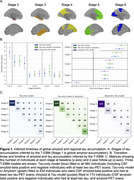 Figure 1
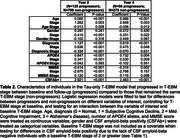 Figure 2
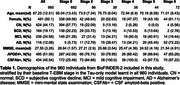 Figure 3
Peer Reviews
No public reviews on file for this paper yet. If you reviewed it on a platform where reviews are public (OpenReview, ICLR, NeurIPS, ICML), you can paste yours below so the community can read it here.
Videos
No videos yet. Explain this paper in a talk, walkthrough, or lecture? Add one.
Taxonomy
TopicsDementia and Cognitive Impairment Research · Alzheimer's disease research and treatments · Bayesian Methods and Mixture Models