Association of Remnant Cholesterol With Self‑Reported Trouble Sleeping and Mediation by Depression
Qichao Yang, Zhaoxiang Wang, Han Yan, Xuejing Shao

TL;DR
Higher levels of remnant cholesterol are linked to trouble sleeping in U.S. adults, with depression partially explaining this connection.
Contribution
This study identifies a novel association between remnant cholesterol and sleep issues, partially mediated by depression.
Findings
Higher remnant cholesterol levels are significantly associated with increased trouble sleeping.
A linear relationship between remnant cholesterol and trouble sleeping was confirmed using restricted cubic spline analysis.
Depression partially mediates the relationship between remnant cholesterol and trouble sleeping.
Abstract
Remnant cholesterol (RC) is an independent risk factor for cardiovascular diseases. The objective of this study is to assess the correlation between RC levels and trouble sleeping among U.S. adults. This study analyzed data from 14,617 adults enrolled in the National Health and Nutrition Examination Survey (NHANES), calculating RC by subtracting both high‐density and low‐density lipoprotein cholesterol (HDL‐c and LDL‐c) from total cholesterol (TC). Trouble sleeping was identified through self‐report history. The relationship between RC and trouble sleeping was explored through logistic regression, restricted cubic spline (RCS), and mediation analysis. The prevalence of trouble sleeping escalates with increasing RC levels. Adjusting for potential confounders, higher RC levels were significantly associated with an increased risk of trouble sleeping [OR (95% CI): 1.30 (1.13–1.49), p <…
Genes, proteins, chemicals, diseases, species, mutations and cell lines named across the full text — each resolved to its canonical identifier and authoritative record.
Click any figure to enlarge with its caption.
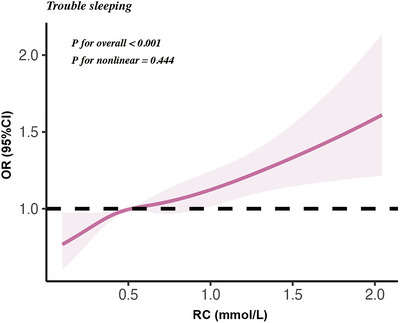 Figure 1
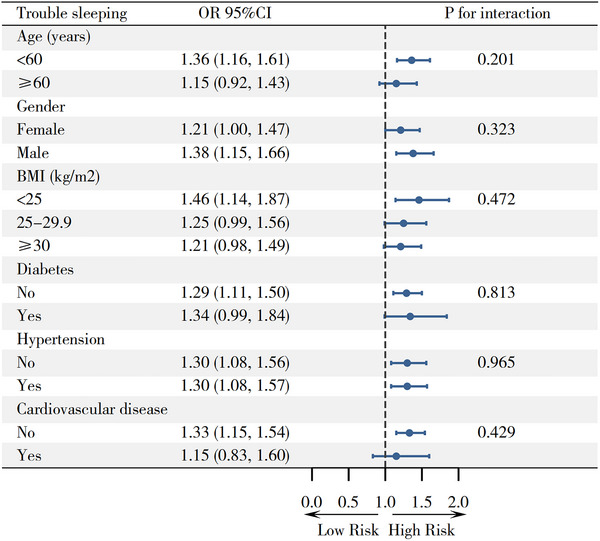 Figure 2
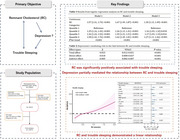 Figure 3
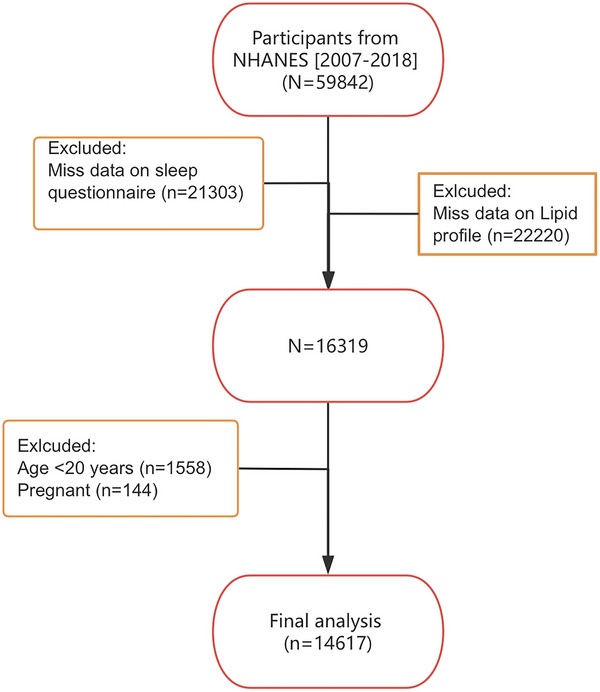 Figure 4
Peer Reviews
No public reviews on file for this paper yet. If you reviewed it on a platform where reviews are public (OpenReview, ICLR, NeurIPS, ICML), you can paste yours below so the community can read it here.
Videos
No videos yet. Explain this paper in a talk, walkthrough, or lecture? Add one.
Taxonomy
TopicsCardiac Health and Mental Health · Diabetes, Cardiovascular Risks, and Lipoproteins · Nutritional Studies and Diet