An umbrella review of barriers, facilitators, and interventions for children and youth with disabilities
Leanne Abungin, Sangeetha Saravanan, Mia Carbone, Kelly Kasper, Jennifer Leo, Carolyn Millar, Kelly P Arbour-Nicitopoulos, Timothy Ross, Amanda Ross-White, Amy Tregubov, Eun-Young Lee

TL;DR
This review explores how children and youth with disabilities experience active play, identifying barriers, facilitators, and interventions to promote inclusion and health.
Contribution
The study provides a comprehensive synthesis of active play definitions, barriers, and interventions for children with disabilities using the Social Ecological Model.
Findings
Active play is seen as fun, spontaneous, and intrinsically motivated by children with disabilities.
Barriers include psychological factors, lack of social support, and policy gaps.
Effective interventions include assistive technologies and inclusive playground designs.
Abstract
Children and youth with disabilities have fewer opportunities for structured and unstructured active play than their peers without disabilities. This umbrella review explored how active play is defined and perceived among children and youth with disabilities and their adult facilitators, and identified barriers, facilitators, and interventions influencing active play among children and youth with disabilities. A total of 18 review articles were deemed eligible and synthesized guided by the Social Ecological Model (SEM). Among children and youth with disabilities, active play was defined as fun, spontaneous, and intrinsically motivated, with some seeking intense, meaningful experiences. Reviews also reported that children and youth with disabilities value active play as a means to maintain autonomy and connections but also feel excluded from peers. Adult facilitators appear to recognize…
Genes, proteins, chemicals, diseases, species, mutations and cell lines named across the full text — each resolved to its canonical identifier and authoritative record.
Click any figure to enlarge with its caption.
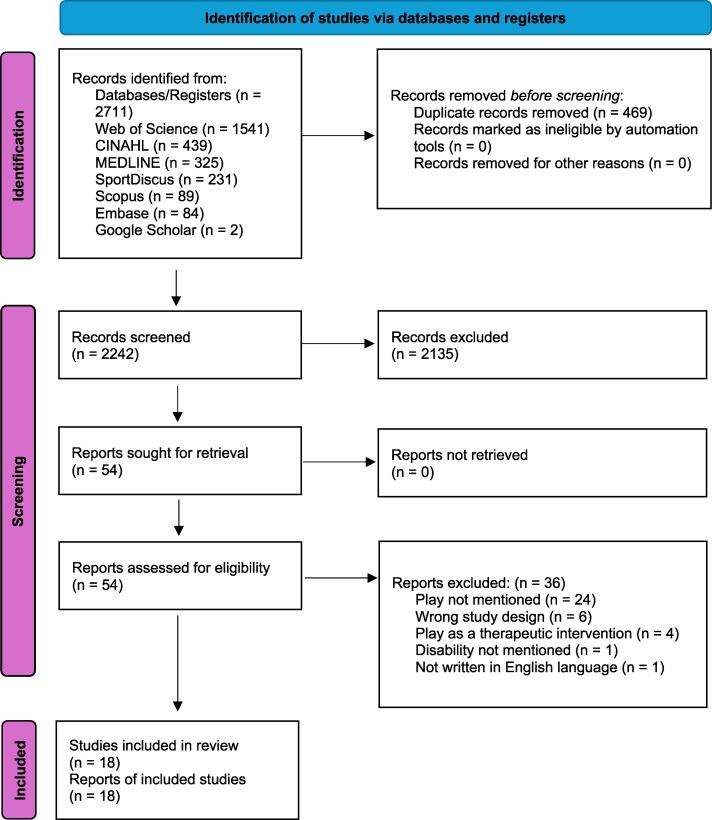 Figure 1
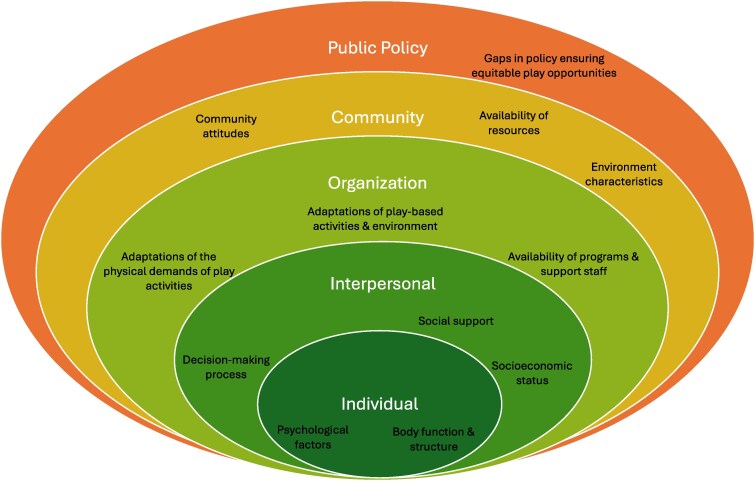 Figure 2
Peer Reviews
No public reviews on file for this paper yet. If you reviewed it on a platform where reviews are public (OpenReview, ICLR, NeurIPS, ICML), you can paste yours below so the community can read it here.
Videos
No videos yet. Explain this paper in a talk, walkthrough, or lecture? Add one.
Taxonomy
TopicsChild Therapy and Development · Inclusion and Disability in Education and Sport · Cerebral Palsy and Movement Disorders