First submillimeter lights from Dome A: Tracing the carbon cycle in the feedback of massive stars
Yan Gong, Jiaqiang Zhong, Yuan Ren, Yilong Zhang, Daizhong Liu, Yiping Ao, Qijun Yao, Wen Zhang, Wei Miao, Zhenhui Lin, Wenying Duan, Dong Liu, Kangmin Zhou, Jie Liu, Zheng Wang, Junda Jin, Kun Zhang, Feng Wu, Jinpeng Li, Boliang Liu, Xuan Zhang, Zhengheng Luo, Jiameng Wang

TL;DR
New submillimeter observations from Dome A reveal how massive stars influence the carbon cycle in space.
Contribution
First submillimeter CO and [CI] maps from Dome A, enabling full carbon cycle analysis in star-forming regions.
Findings
Elevated CO/CO abundance ratios found in high-extinction regions.
Massive star radiation fields penetrate clumpy ISM, affecting carbon phases.
Observations mark a milestone for submillimeter astronomy at Dome A.
Abstract
The cycling of carbon between its ionized, atomic, and molecular phases shapes the chemical compositions and physical conditions of the interstellar medium (ISM). However, ground-based studies of the full carbon cycle have been limited by atmospheric absorption. Dome A, the most promising site for submillimeter astronomy, has long resisted successful submillimeter astronomical observations. Using the 60-centimeter Antarctic Terahertz Explorer, we present the first successful CO (4-3) and [CI] (P13−P03) mapping observations of two archetypal triggered massive star-formation regions at Dome A. These data, together with archival [CII], provide the first complete characterization of all three carbon phases in these environments. We find elevated C0/CO abundance ratios in high-extinction regions, plausibly driven by deep penetration of intense radiation fields from massive stars into a…
Genes, proteins, chemicals, diseases, species, mutations and cell lines named across the full text — each resolved to its canonical identifier and authoritative record.
Click any figure to enlarge with its caption.
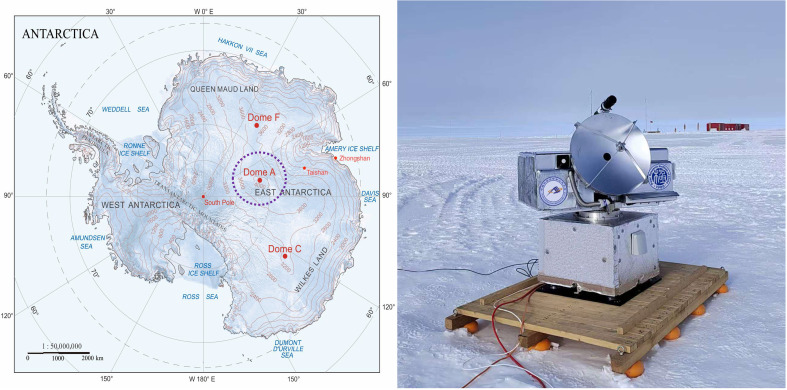 Figure 1
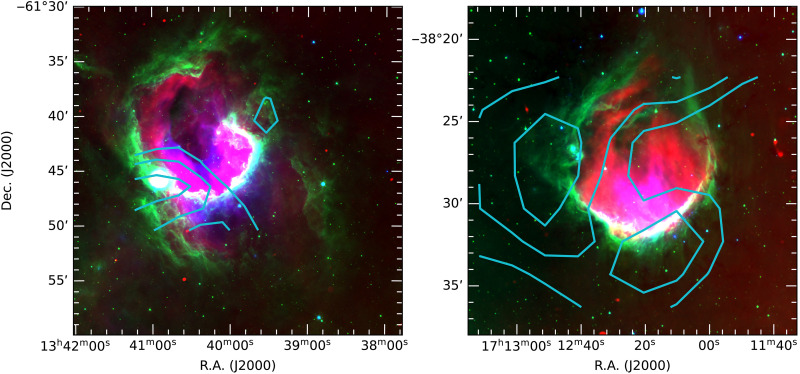 Figure 2
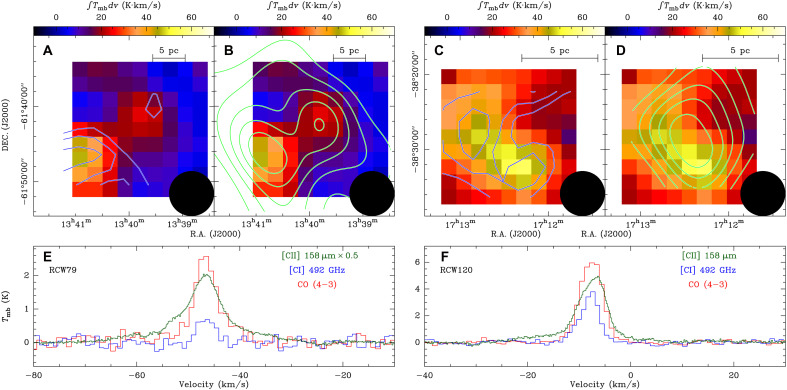 Figure 3
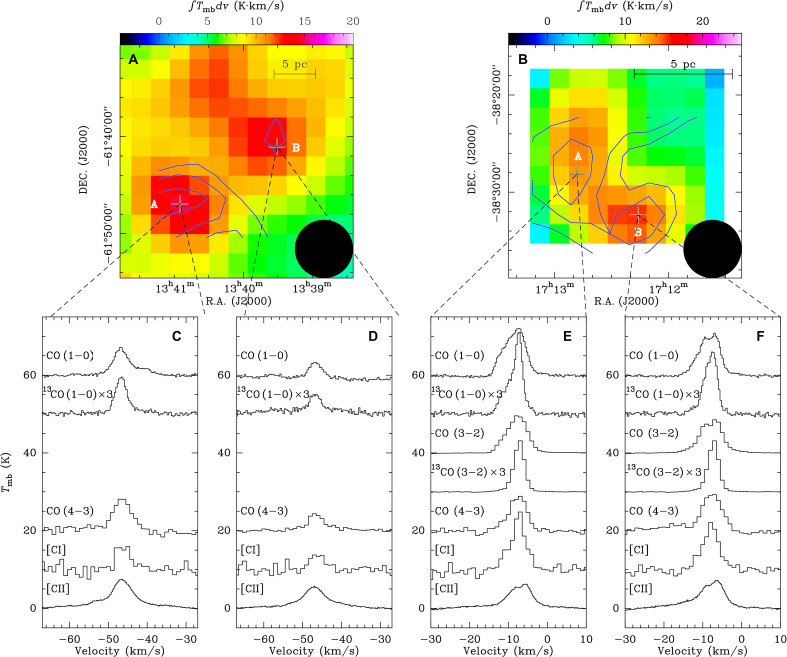 Figure 4
Peer Reviews
No public reviews on file for this paper yet. If you reviewed it on a platform where reviews are public (OpenReview, ICLR, NeurIPS, ICML), you can paste yours below so the community can read it here.
Videos
No videos yet. Explain this paper in a talk, walkthrough, or lecture? Add one.
Taxonomy
TopicsAstrophysics and Star Formation Studies · Astro and Planetary Science · Fullerene Chemistry and Applications