Friction-driven scission: How nonlocal mechanisms contribute to membrane fission across domains of life
Ane Landajuela, Carolina Gomis Perez, Patricia Bassereau, Andrew Callan-Jones, Erdem Karatekin

TL;DR
The paper explains how a new mechanism called friction-driven scission helps membranes split in cells by using tension and protein scaffolds.
Contribution
The paper introduces friction-driven scission as a novel, conserved mechanism for membrane fission across all domains of life.
Findings
Friction-driven scission relies on a membrane tension gradient and a protein scaffold to cause membrane fission.
This mechanism is conserved from bacteria to humans and requires only two components.
Friction-driven scission may be more common in cells than previously recognized.
Abstract
Membrane fission is an energy-consuming process, critical for all domains of life. Prototypical fission machineries use local energy input such as nucleoside triphosphate hydrolysis to constrict and cut membranes. However, some membrane fission reactions paradoxically rely on protein scaffolds that by themselves stabilize rather than cut membranes. It turns out these proteins do not work alone; they use nonlocal energy input that generates a membrane tension gradient. Such a gradient mobilizes membrane flow that in turn tends to relax the membrane tension gradient. By interfering with membrane flow, the protein scaffold causes the membrane tension to increase unchecked to the point of mechanical failure, membrane fission. This friction-driven scission (FDS) mechanism is generic, conserved from bacteria to humans, and only requires two ingredients: a membrane tension generating process…
Genes, proteins, chemicals, diseases, species, mutations and cell lines named across the full text — each resolved to its canonical identifier and authoritative record.
Click any figure to enlarge with its caption.
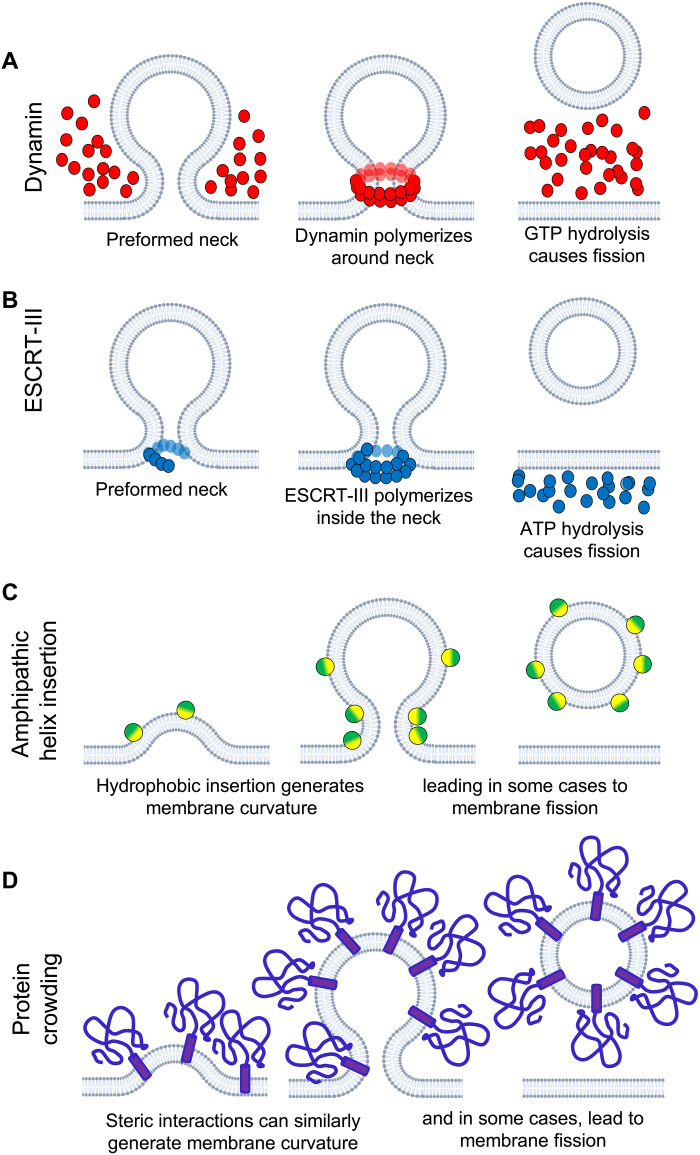 Figure 1
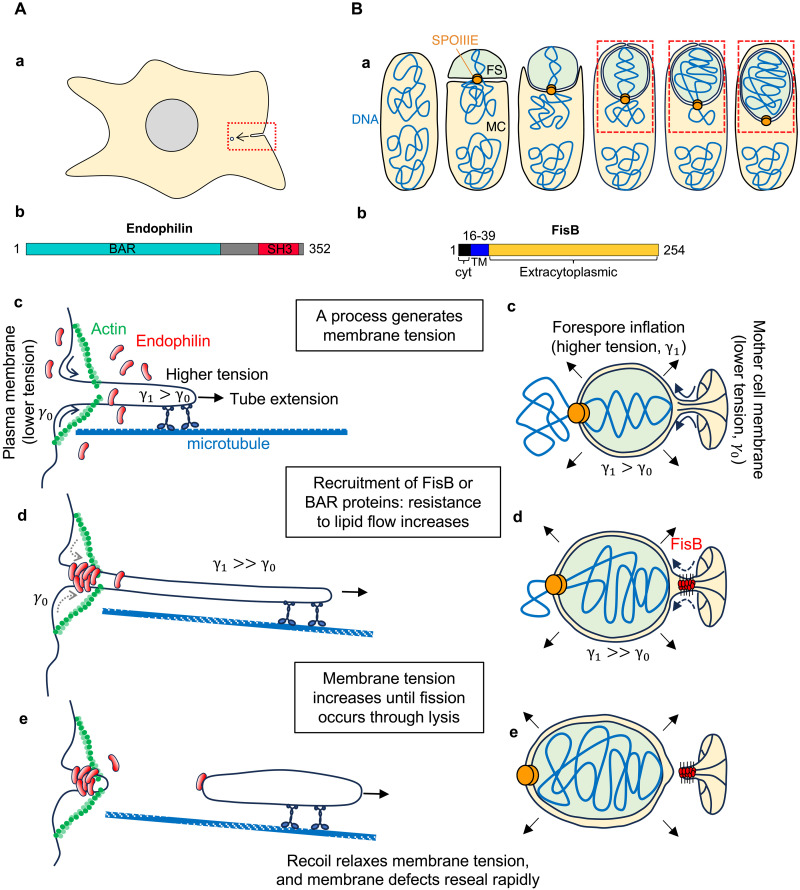 Figure 2
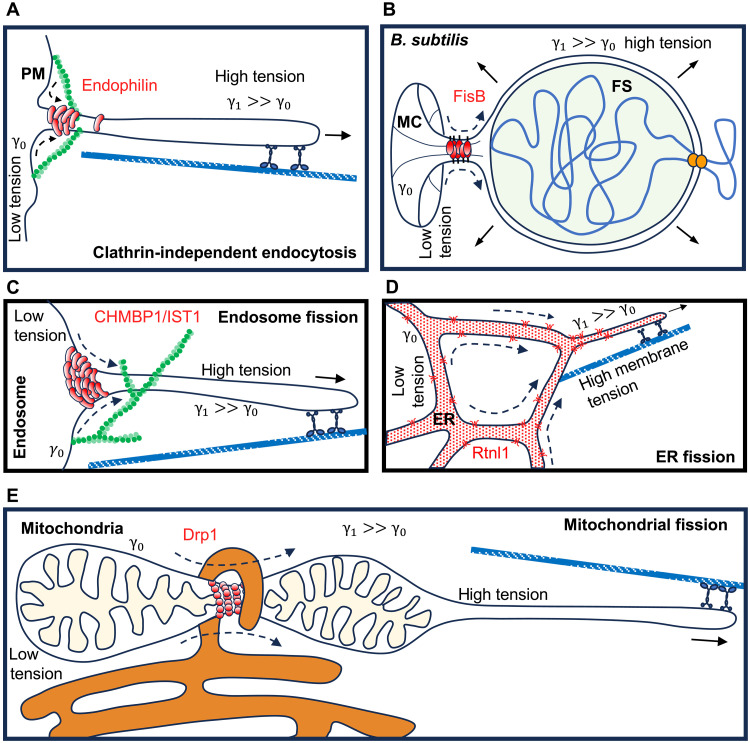 Figure 3
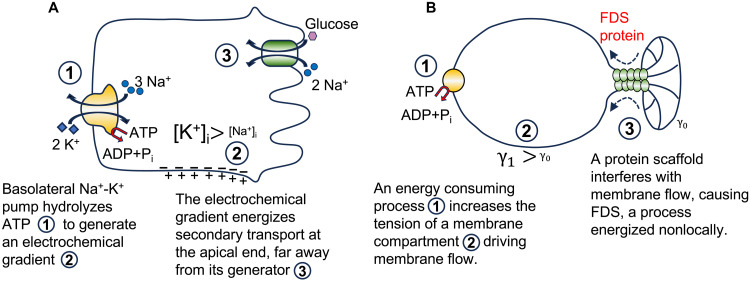 Figure 4
Peer Reviews
No public reviews on file for this paper yet. If you reviewed it on a platform where reviews are public (OpenReview, ICLR, NeurIPS, ICML), you can paste yours below so the community can read it here.
Videos
No videos yet. Explain this paper in a talk, walkthrough, or lecture? Add one.
Taxonomy
TopicsBacterial Genetics and Biotechnology · Lipid Membrane Structure and Behavior · ATP Synthase and ATPases Research