How to visually diagnose mechanical dyssynchrony in cardiac resynchronization therapy candidates using echocardiography
Pedro G Diogo, Kenji Demesure, Alexis Puvrez, Gábor Vörös, Jürgen Duchenne, Jens-Uwe Voigt

TL;DR
This paper provides a step-by-step guide for using echocardiography to visually identify mechanical dyssynchrony in patients being considered for cardiac resynchronization therapy.
Contribution
The paper introduces a practical four-step workflow for visually diagnosing mechanical dyssynchrony using echocardiography to improve CRT patient selection.
Findings
Mechanical dyssynchrony can be visually identified through septal flash and apical rocking patterns.
Visual assessment of mechanical dyssynchrony may improve CRT response rates by better patient selection.
The AMEND-CRT trial is evaluating the clinical utility of incorporating septal flash and apical rocking assessment.
Abstract
Cardiac resynchronization therapy (CRT) improves outcomes in patients with heart failure and broad QRS complex, yet 20–45% do not respond. Mechanical dyssynchrony (MechDys)—identified visually by septal flash and/or apical rocking (SFoAR)—is strongly associated with CRT benefit. This ‘How to’ paper outlines a practical four-step workflow for the visual assessment of MechDys. First, a high-quality, multi-view echocardiographic acquisition is essential. Second, septal flash4 (SF) is recognized as an early leftward septal motion, often with rebound, preceding lateral wall contraction; its magnitude depends on conduction delay, myocardial contractility, and right heart loading. Third, ApR is identified as a biphasic apical motion reflecting sequential septal and lateral wall contractions; its appearance may be modified by scarring, pacing, or imaging artefacts. MechDys is confirmed when…
Genes, proteins, chemicals, diseases, species, mutations and cell lines named across the full text — each resolved to its canonical identifier and authoritative record.
Click any figure to enlarge with its caption.
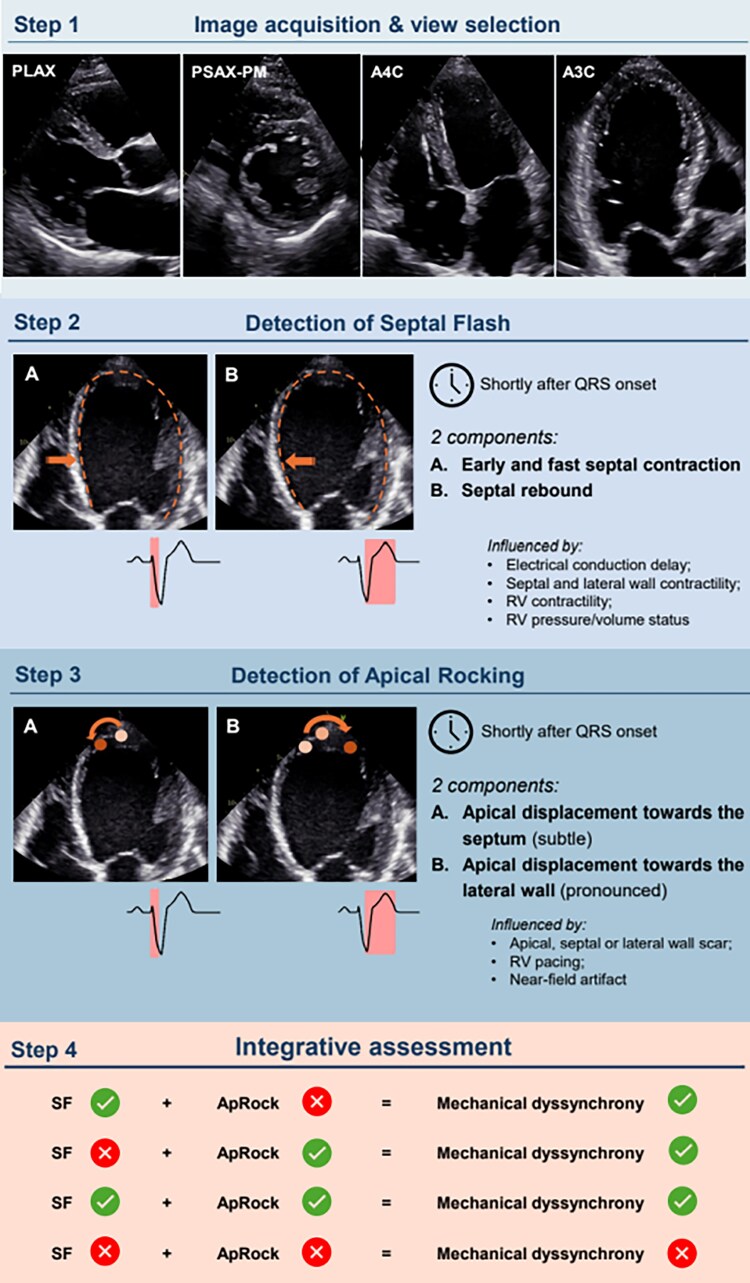 Figure 1
Peer Reviews
No public reviews on file for this paper yet. If you reviewed it on a platform where reviews are public (OpenReview, ICLR, NeurIPS, ICML), you can paste yours below so the community can read it here.
Videos
No videos yet. Explain this paper in a talk, walkthrough, or lecture? Add one.
Taxonomy
TopicsCardiac pacing and defibrillation studies · Transplantation: Methods and Outcomes · Mechanical Circulatory Support Devices