Genetic and Clinical Spectrum of Hereditary Transthyretin Amyloidosis in Brazil
Gustavo Maximiano‐Alves, Carolina Lavigne‐Moreira, Marcus Vinicius Simões, Adilson Junior Pinto Galvão, Flavio Henrique Valicelli, Fernando Saraiva Coneglian, Elisa Vegezzi, Pedro Manoel Marques Garibaldi, Pedro José Tomaselli, Andrea Cortese, Wilson Marques

TL;DR
This study explores the genetic and clinical diversity of a hereditary amyloidosis disease in Brazil, highlighting regional and ethnic differences in symptom onset.
Contribution
The study identifies a distinct geographic pattern of disease onset in Brazil and emphasizes the impact of ethnicity on age of onset.
Findings
Seven TTR pathogenic variants were identified in a Brazilian cohort, with p.Val50Met being the most common.
Late-onset V30M cases are more frequent in Brazil's central region, while early-onset V30M is more common in São Paulo/South.
Familial cases presented with a 20.5-year earlier age of onset compared to sporadic cases.
Abstract
Transthyretin hereditary amyloidosis (ATTRv) clinical variability has been widely reported, not only across countries and variants but also among families and distinct regions within a single nation. One of the principal challenges in disease management is the accurate determination of age of onset (AOO), which is heterogeneous and has therapeutic implications given the availability of disease‐modifying treatments. This study characterizes the genetic landscape and clinical onset spectrum of ATTRv in an admixed Brazilian cohort of 175 patients. Seven TTR pathogenic variants (p.Val50Met, p.Val142Ile, p.Ile127Val, p.Ile88Leu, p.Ala39Asp, p.Phe84Leu, p.Tyr98Phe) were identified. The most common was p.Val50Met (58.8%), followed by p.Val142Ile (29.7%) and p.Ile127Val (7.4%). Notably, 44% of V122I had a neurological onset. Close clinical monitoring of presymptomatic carriers reduced age at…
Genes, proteins, chemicals, diseases, species, mutations and cell lines named across the full text — each resolved to its canonical identifier and authoritative record.
Click any figure to enlarge with its caption.
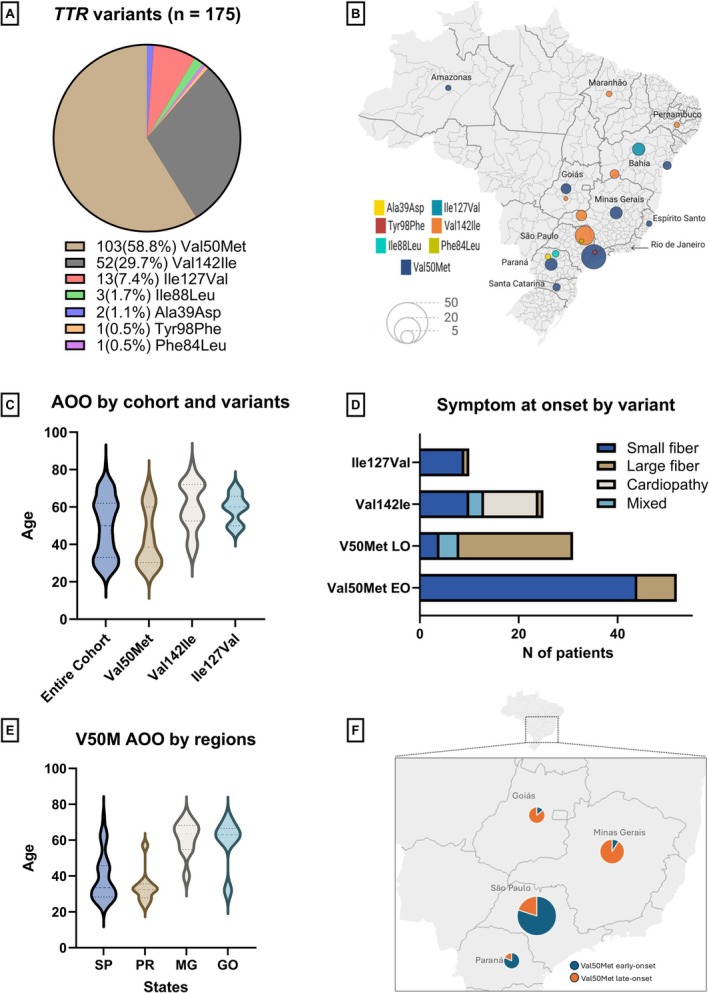 Figure 1
Peer Reviews
No public reviews on file for this paper yet. If you reviewed it on a platform where reviews are public (OpenReview, ICLR, NeurIPS, ICML), you can paste yours below so the community can read it here.
Videos
No videos yet. Explain this paper in a talk, walkthrough, or lecture? Add one.
Taxonomy
TopicsAmyloidosis: Diagnosis, Treatment, Outcomes · Parathyroid Disorders and Treatments · Alzheimer's disease research and treatments