A scoping review on the use of virtual patients for enhancing empathy in medical students
Rie Yamada, Kaori Futakawa, Satoshi Kondo, Kuangzhe Xu, Satoshi Okazaki

TL;DR
This review explores how virtual patients can help medical students develop empathy, highlighting current research gaps and suggesting ways to improve training methods.
Contribution
The study identifies five key research gaps in using virtual patients for empathy training in medical education.
Findings
Eighteen studies involving 1,920 medical students were analyzed, revealing limited diversity in clinical scenarios and assessment methods.
Five research gaps were identified, including a lack of explicit empathy definitions and insufficient evidence on sustained empathy outcomes.
Most studies used single-arm pre-post designs, indicating a need for more rigorous experimental approaches.
Abstract
Virtual patients have been increasingly utilized in medical education to develop empathy in a structured and scalable manner. Compared with traditional methods such as clinical practice and standardized patients, virtual patients can offer reproducible, resource-efficient learning experiences. This scoping review maps the research on virtual patient-based interventions designed to foster empathy in medical students. It seeks to identify existing research gaps, including conceptual definitions of empathy, scenario design, instructional strategies, assessment methods, and outcome measures. The Joanna Briggs Institute’s scoping review methodology was followed, and the PRISMA-ScR guidelines for reporting were used. A comprehensive search was conducted in PubMed, CINAHL, ERIC, Web of Science, Scopus, and the Cochrane Library. Two independent reviewers screened all titles, abstracts, and full…
Genes, proteins, chemicals, diseases, species, mutations and cell lines named across the full text — each resolved to its canonical identifier and authoritative record.
Click any figure to enlarge with its caption.
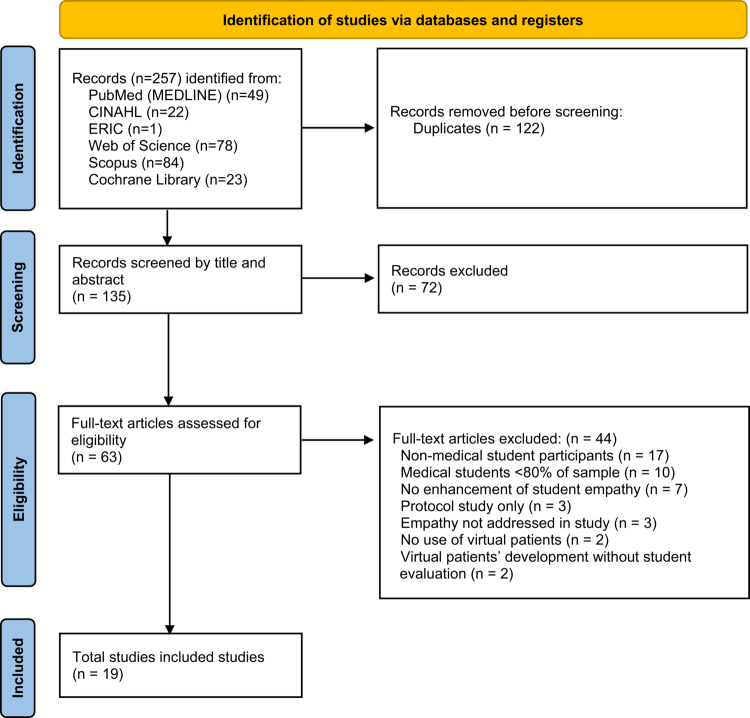 Figure 1
Peer Reviews
No public reviews on file for this paper yet. If you reviewed it on a platform where reviews are public (OpenReview, ICLR, NeurIPS, ICML), you can paste yours below so the community can read it here.
Videos
No videos yet. Explain this paper in a talk, walkthrough, or lecture? Add one.
Taxonomy
TopicsEmpathy and Medical Education · Simulation-Based Education in Healthcare · Media Influence and Health