Retrograde intra renal surgery (RIRS) versus percutaneous nephrolithotomy (PNL) as a primary treatment for large renal stones: A prospective randomized controlled trial
Ayman Kassem, Hesham Torad, Ahmed Essam, Mahmoud Abdel Hamid, Sameih Zamel, Amr Elkady

TL;DR
This study compares two kidney stone treatments, RIRS and PNL, finding that RIRS offers similar success rates with fewer complications and shorter recovery times for stones 2–3 cm in size.
Contribution
The study provides a direct comparison of RIRS and PNL for large renal stones through a prospective randomized trial.
Findings
RIRS and PNL had comparable stone-free rates (70.5% vs 73.8%) for 2–3 cm stones.
RIRS resulted in shorter hospital stays, less pain, and no blood transfusions compared to PNL.
PNL had a longer lithotripsy time and a higher risk of sepsis and mortality.
Abstract
Despite the high efficacy of percutaneous nephrolithotomy (PNL), it has more morbidity and a difficult learning curve. Retrograde intra renal surgery (RIRS) was introduced as a minimally invasive procedure for treatment of renal stones. To compare RIRS versus PNL in the management of renal stones sized 2–3 cm. In this prospective randomized controlled trial, 122 patients with renal stones 2–3 cm were included and divided into two equal groups. Group A underwent RIRS. Group B underwent PNL. Patients with bleeding disorders, pregnancy, active UTI were excluded. Laboratory investigations, Ultrasound, CTUT were done preoperatively. Perioperative outcome (operative time, complications, hospital stay and pain score) was recorded. SFR (stone free rate) was assessed by CTUT after one month. The mean stone size for group A and B were 2.11 ± 0.21 and 2.12 ± 0.23, respectively. The Stone free…
Genes, proteins, chemicals, diseases, species, mutations and cell lines named across the full text — each resolved to its canonical identifier and authoritative record.
Click any figure to enlarge with its caption.
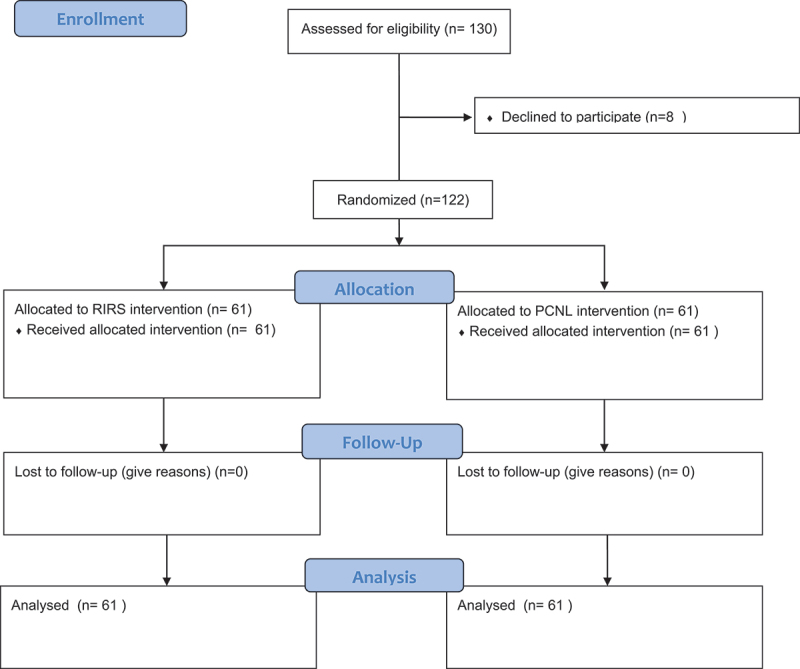 Figure 1
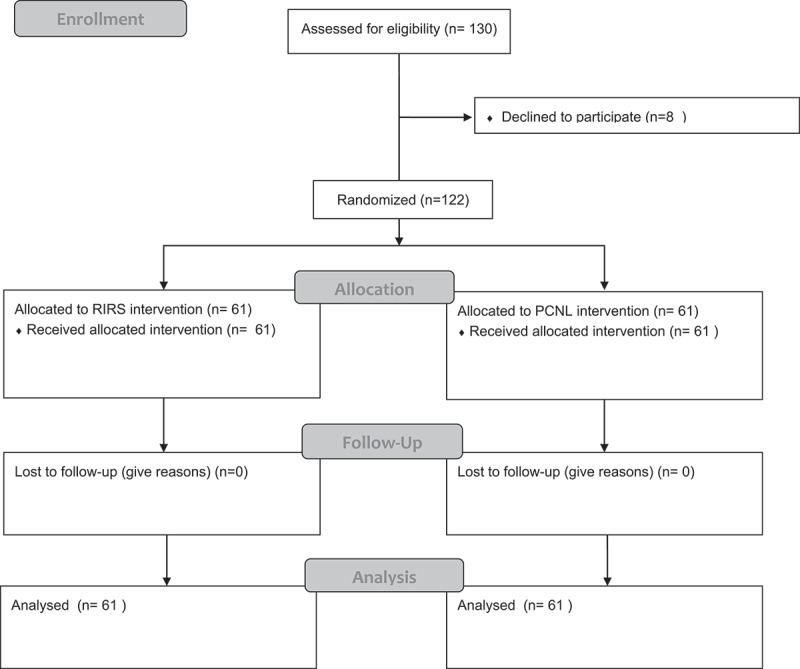 Figure 2
Peer Reviews
No public reviews on file for this paper yet. If you reviewed it on a platform where reviews are public (OpenReview, ICLR, NeurIPS, ICML), you can paste yours below so the community can read it here.
Videos
No videos yet. Explain this paper in a talk, walkthrough, or lecture? Add one.
Taxonomy
TopicsKidney Stones and Urolithiasis Treatments · Pediatric Urology and Nephrology Studies · Paleopathology and ancient diseases